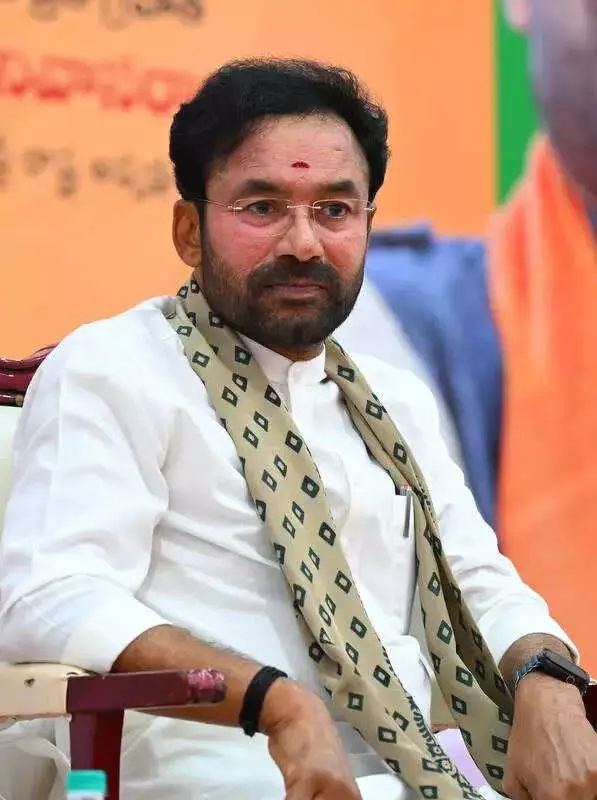
Union Minister for Coal and Mines, G Kishan Reddy, launched a sharp critique against the Congress-led Telangana state government on Thursday, accusing it of having no concrete strategy to address the state's escalating electricity needs. During a press conference in Hyderabad, the minister raised alarms over financial burdens and questioned the intent behind key power sector decisions.
Allegations of Debt Burden and Questionable Discom
Reddy alleged that the state's proposal to establish a new power distribution company (discom) was a move designed to accumulate massive debt. He claimed the plan involved transferring existing liabilities of ₹26,000 crore in dues to the state power generation corporation (Genco) onto the new entity. Furthermore, he stated the discom planned to raise an additional ₹9,000 crore loan, potentially piling up a significant financial burden.
The Union Minister pointed out that Telangana's existing discoms already suffer from poor credit ratings. He questioned the logic behind creating a new distribution company that promises free electricity, suggesting it lacked a sustainable revenue model. "Reliable power is crucial for establishing Hyderabad as a global hub, but the state government's actions, or lack thereof, are concerning," Reddy stated.
Unpaid Dues Crippling Welfare and Wages
Reddy highlighted a critical issue plaguing the state-owned Singareni Collieries Company Limited (SCCL). He revealed that due to ₹47,000 crore in unpaid dues from the state government, Singareni was unable to contribute to the District Mineral Foundation (DMF) trust. This fund is vital for local area development and welfare schemes in mining regions.
The financial strain has also led to delays in paying workers' salaries. The minister directly demanded clarity from Chief Minister Revanth Reddy on a timeline for settling these wage payments to Singareni employees.
Warning Against Costly Private Power Reliance
A major point of contention raised by Kishan Reddy was the state's approach to power procurement. He noted that while the 1,600 MW unit from NTPC's Ramagundam plant is operational, the Telangana government has not signed a Power Purchase Agreement (PPA) for the remaining 2,400 MW from the same project.
He warned that this indecision could force the state to buy expensive power from private generators. "If power is generated by the private sector, the burden will ultimately fall on the people of Telangana," Reddy asserted. He emphasized that private companies incur higher costs than NTPC, and demanded the state government clarify who would bear this extra financial load.
The Union Minister's statements underscore a growing political debate over Telangana's energy security and fiscal management, with calls for immediate transparency on several high-stakes financial and operational issues in the power sector.