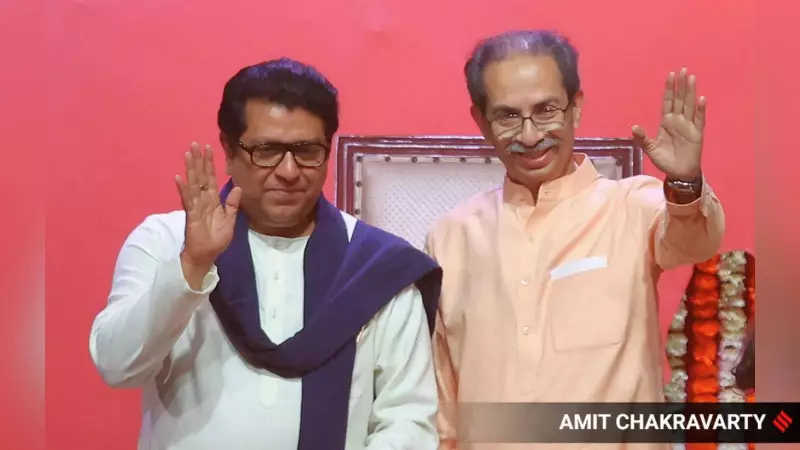
In a significant political realignment, estranged cousins Uddhav Thackeray and Raj Thackeray have decided to bury a two-decade-old hatchet and join forces. Their alliance, aimed at the crucial upcoming municipal corporation elections in Maharashtra, particularly in Mumbai, marks a dramatic shift as they attempt to migrate from being former BJP allies to becoming its principal challengers in the state.
A Legacy Divided, Now United Against a Common Foe
The rift between the Thackeray cousins dates back to 2006 when Raj, once seen as the heir apparent to his charismatic uncle Bal Thackeray, founded the Maharashtra Navnirman Sena (MNS) after the Shiv Sena patriarch chose his son, Uddhav, as his political successor. For nearly 20 years, the two factions operated separately, often as rivals, with their animosity defining a significant part of Maharashtra's political narrative.
Uddhav Thackeray's Shiv Sena enjoyed a three-and-a-half-decade-long alliance with the BJP until the dramatic events of 2019. That year, Uddhav broke away to form the Maha Vikas Aghadi (MVA) government with the Nationalist Congress Party and Congress, a move that robbed the BJP's Devendra Fadnavis of a second term as Chief Minister. The BJP's retaliation was swift and severe. It engineered a split within the Shiv Sena, leading to the defection of Uddhav's key lieutenant, Eknath Shinde, who took a majority of legislators with him. This not only cost Uddhav the chief minister's chair but also served as a stark lesson in realpolitik.
Meanwhile, Raj Thackeray's MNS witnessed a massive erosion of its support base. His political pendulum swung from being a staunch BJP supporter to one of its harshest critics. The BJP, as part of its larger strategy, first outflanked the Shiv Sena on the Hindutva agenda and later co-opted its core "Marathi Manoos" plank. Having successfully split the Shiv Sena, the BJP found it no longer needed either of the Thackeray brothers, leaving both politically cornered.
The Revival of the Marathi Plank and a New Battle Line
This political marginalization is the primary driver behind the newfound bonhomie. The alliance between Shiv Sena (UBT) and MNS is a direct attempt to challenge the BJP's growing hegemony in Maharashtra. The cousins believe their combined strength could turn the tables on the "saffron samrat" they once courted.
Critically, the issue that has brought them back to their roots is the Marathi identity. The BJP-led state government's recent, ill-timed decision to introduce Hindi at the pre-primary level in schools provided the perfect catalyst. Raj Thackeray was the first to challenge the Fadnavis government on this, receiving active support from Uddhav. This move allowed the Thackeray cousins to polish and revive their original political plank, positioning themselves as the defenders of Marathi pride against what they portray as the BJP's centralizing, anti-federal tendencies.
The BJP's recent communal pitch in Mumbai—where a senior leader raised the specter of the city getting a mayor from a minority community if the party wasn't voted in—has further sharpened this battle line. The Thackerays aim to frame the contest as regionalism versus religionism, hoping to emulate the success of leaders like M.K. Stalin in Tamil Nadu or Mamata Banerjee in West Bengal, who have effectively used regional identity to counter the BJP's national narrative.
Can Brand Thackeray Be Refreshed for the Future?
The alliance, however, faces formidable challenges and raises critical questions. Is the issue of Marathi pride still potent enough in a demographically transformed Mumbai to secure electoral victory? Is this reunion too late to pose a credible threat to the well-oiled BJP machinery?
Most analysts agree that neither Uddhav nor Raj possesses the fiery, galvanizing charisma of the late Bal Thackeray. It was Balasaheb who, as far back as December 1987, made Hindutva an election issue in a Mumbai suburb, long before the BJP's L.K. Advani's Rath Yatra. He was later disenfranchised for six years for seeking votes on communal lines. The current generation of Thackerays must now write a new chapter.
Their success hinges on their ability to widen their appeal beyond a narrow base and convincingly convert the political discourse into a battle for Maharashtra's identity. The upcoming civic polls, especially for the coveted Brihanmumbai Municipal Corporation (BMC), will be the first major test of this alliance. It is an opportunity for the Thackeray cousins to prove their political mettle and determine the longevity of the Brand Thackeray in Indian politics. The outcome will not only shape Mumbai's municipal landscape but also signal whether a united Thackeray front can emerge as the nucleus of a sustained opposition to the BJP in Maharashtra.