
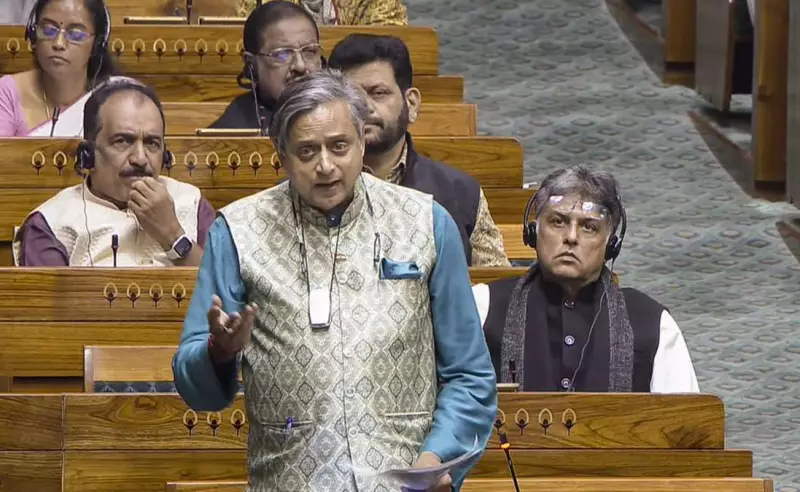
Senior Congress leader and Member of Parliament Shashi Tharoor has publicly endorsed the ongoing demolition drive against illegal structures in Bengaluru, a move that has ignited significant internal dissent within his own party. Tharoor's stance, articulated on social media platform X, places him at odds with several state party colleagues who have vehemently criticized the Karnataka government's actions.
Tharoor's Rationale for Supporting the Drive
In his detailed post, Tharoor presented a nuanced argument in favor of the demolition campaign. He emphasized that the primary targets of the drive are illegal constructions encroaching upon stormwater drains (rajakaluves), which have been identified as a major cause of the severe flooding that crippled Bengaluru during recent monsoons. The MP argued that while the actions may seem harsh, they are a necessary corrective measure for past administrative failures.
"The demolitions are not arbitrary but targeted," Tharoor asserted, framing the issue as one of public safety versus illegal private gain. He stressed that protecting the city's drainage infrastructure is critical to preventing future urban flooding disasters. His comments aimed to shift the narrative from political blame to a matter of civic responsibility and urban planning.
Internal Party Backlash and Political Repercussions
Tharoor's defense has not been well-received by a section of the Karnataka Congress. Several party leaders and legislators have openly expressed their discontent, viewing the drive as disproportionately affecting the poor and middle class while being lenient on powerful entities. This internal rift highlights the delicate balancing act for the Congress, which leads the state government and must enforce the law while managing political fallout.
The dissent underscores a classic political dilemma: the conflict between implementing necessary urban governance measures and maintaining populist support. Party workers on the ground fear electoral backlash from affected communities, creating tension with the administration's stated goal of enforcing zoning laws and clearing critical infrastructure.
Broader Context: Bengaluru's Urban Crisis
The demolition drive, which gained momentum in early January, is a direct response to the catastrophic floods of 2022 and subsequent waterlogging issues. Experts have long warned that the unchecked encroachment of lakes and drainage channels has severely compromised Bengaluru's natural water flow system. The government's action, though controversial, is positioned as a long-term solution to a chronic urban problem.
Authorities have stated that the focus remains on illegal structures built on government land and drain networks, not on authorized properties. However, the implementation has sparked protests and legal challenges from resident welfare associations and affected business owners, adding layers of complexity to the situation.
Analysis: A Rare Stance and Its Implications
Shashi Tharoor's position is notable for its departure from typical opposition rhetoric. By supporting a state government action based on technical and environmental grounds, he has sparked a debate that transcends immediate political lines. This stance could be seen as an attempt to advocate for evidence-based policy over partisan politics, especially on issues of urban sustainability and disaster prevention.
The fallout within the Congress party illustrates the challenges of cohesive policy messaging. While the state government proceeds with its drive, backed by court directives, the party must manage internal unity and public perception. Tharoor's intervention adds a significant voice to the discourse, potentially influencing public opinion and putting pressure on critics within his party to reconsider their stance based on the broader public interest argument.
As Bengaluru grapples with its infrastructure limits, this episode marks a critical moment in the city's development politics, where environmental imperatives and political compulsions are on a visible collision course.