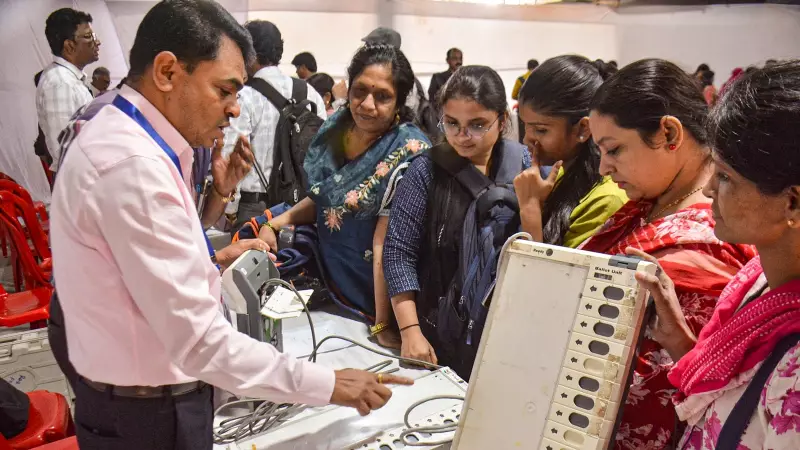
The Thane Municipal Corporation (TMC) election, scheduled for January 15, has emerged as a defining political battle in Maharashtra. After a gap of nearly nine years, the polls are set to determine who controls the civic body of this crucial city, which has long been a traditional stronghold of the Shiv Sena. The contest is sharply framed as a clash between the formidable organisational machinery of Deputy Chief Minister Eknath Shinde and the potent emotional appeal of the Thackeray legacy, championed by Uddhav Thackeray and his cousin Raj Thackeray.
The Battle of Numbers and Legacy
The arithmetic on the ground heavily favours the ruling faction led by Eknath Shinde. Following the dramatic split in the Shiv Sena in June 2022, the balance of power in Thane shifted decisively. Of the 67 corporators elected in the 2017 civic polls, a staggering 66 have now aligned with the Shinde-led Shiv Sena. Furthermore, the party holds all the MLAs and MPs from the region, and crucially, commands the loyalty of most of the undivided Shiv Sena's local shakhas (ward-level branches). This continuity of workers, leaders, and ward-level networks provides a significant infrastructural advantage.
Adding to this strength, six candidates from Shinde's Sena have already been elected unopposed, even before voters head to the polls. A senior functionary from the Shinde camp confidently stated that the familiarity and accessibility of their workers, who are known for solving people's problems, will lead them to victory.
In stark contrast, the Uddhav Thackeray-led Shiv Sena (UBT) faces a clear organisational deficit. With most shakhas and corporators gone, their campaign, spearheaded jointly by Uddhav and Raj Thackeray, is banking heavily on sentiment and legacy. Their rallies and outreach aim to test whether the Thackeray name still carries electoral weight in the city shaped by the legacy of Balasaheb Thackeray and the late Anand Dighe. As an elderly voter in Naupada remarked, the emotional connection to Balasaheb's Sena does not disappear easily.
Seat Sharing and Alliance Dynamics
The Thane Municipal Corporation comprises 131 seats. Within the ruling Mahayuti alliance, the seat-sharing formula itself underscores Shinde's dominance: his Shiv Sena is contesting 87 seats, while the Bharatiya Janata Party (BJP) is contesting 40, with smaller allies getting four.
The BJP's approach in Thane has been notably careful. Despite its growing urban footprint in Maharashtra and internal voices pushing for an independent contest, the party leadership chose to remain a junior partner. Chief Minister Devendra Fadnavis explained the conscious decision to accept fewer seats, stating that in Balasaheb Thackeray's favourite city, a conflict within the alliance would not have been right. A senior BJP worker confirmed that the top leadership's message was clear: not to disturb the alliance in Thane.
The opposition camp presents a more fragmented picture. The Shiv Sena (UBT) is contesting 53 seats, the Maharashtra Navnirman Sena (MNS) 34, and the Sharad Pawar-led NCP faction 36. Interestingly, the Ajit Pawar-led NCP, which is part of the ruling alliance at the state and centre, is contesting independently on 75 seats. The Congress, part of the INDIA bloc, is also fighting alone on 96 seats.
Civic Issues and Voter Sentiment
Beyond the high-octane political drama, voters across Thane are primarily concerned with pressing civic issues. Residents repeatedly highlight problems like severe traffic congestion, especially on Ghodbunder Road, poor road conditions, water supply irregularities, and infrastructure strain due to rapid urban growth. The cluster redevelopment of old buildings has also become a contentious topic, with many residents anxious about rehabilitation.
For many, the party label is secondary to effective governance. As a resident of Thane West put it, people approach whoever is visible and accessible to get their daily civic work done. This sentiment underscores the advantage held by the established local network of the Shinde faction.
The split within the NCP has added another layer of complexity, particularly in areas like Mumbra-Kalwa. Both NCP factions are focusing on this belt, where minority voters and hyper-local issues often decide outcomes. Here, as a party worker from Kalwa noted, people vote more on local work than party symbols, and even small margins matter greatly.
What is at Stake in Thane
The outcome of the Thane civic polls will have ramifications far beyond the city's municipal limits. For Eknath Shinde, a strong victory would cement his control over the Shiv Sena's traditional organisational base and validate his claim to Balasaheb Thackeray's legacy. For Uddhav Thackeray, the election is a critical test of whether emotional appeal and legacy loyalty can overcome a lack of organisational machinery on the ground.
For the BJP, the results will indicate how much space the party can carve for itself in a city historically dominated by its ally. For the divided NCP, closely fought wards could offer pockets of influence. Ultimately, the January 15 verdict will decide not just who administers Thane, but who truly holds ground in one of Maharashtra's most politically significant cities.