

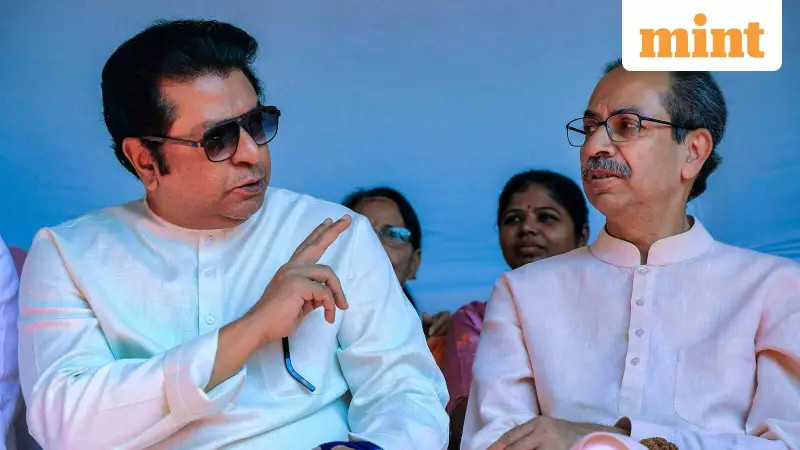
In a dramatic political realignment, estranged cousins Uddhav Thackeray and Raj Thackeray have decided to bury the hatchet and join forces to contest the upcoming Brihanmumbai Municipal Corporation (BMC) elections. The polls, scheduled for January 15 next year, are set to witness a formidable Thackeray alliance taking on the Bharatiya Janata Party's bid for control of India's richest civic body.
A Two-Decade Rift Healed for Political Survival
The official announcement of this historic reunion is slated to be made today in Mumbai, as confirmed by Shiv Sena (UBT) leader Sanjay Raut. The alliance will see the Uddhav Thackeray-led Shiv Sena (UBT) contest 150 seats, while the Raj Thackeray-led Maharashtra Navnirman Sena (MNS) will field candidates in the remaining 77 seats of the 227-seat BMC. This partnership marks the end of a bitter separation that began in 2006 when Raj Thackeray walked out of the undivided Shiv Sena, miffed over Uddhav's elevation as the party's working president, and floated the MNS.
For the Thackeray family, this is more than an electoral pact; it is a battle for the survival of their political brand. The BMC has been the primary source of the Sena's financial and organisational strength for decades. A defeat here would deal a near-fatal blow to their legacy in Mumbai. The reunion, coming after nearly two decades, is poised to create a tectonic shift in the city's political landscape, potentially turning the election into a 'Thackeray vs The Rest' contest.

Marathi Vote Consolidation and the BJP's Challenge
Analysts point out that the split between the Shiv Sena and the MNS had historically benefited the BJP by dividing the crucial Marathi-speaking vote. A unified Thackeray front now threatens to consolidate this vote bank, especially in central Mumbai and the suburbs. Marathi speakers, who form about 26 per cent of Mumbai's population, have been the core constituency of the Thackerays, who have championed the cause of the 'Marathi manoos'.
This consolidation, coupled with potential support from the city's Muslim population (11%) and Dalits (11%), presents a significant challenge for the BJP. The ruling party has dismissed the alliance as a "desperate act of survival" and is pivoting to a 'Development vs. Dynasty' narrative. It is banking on the support of non-Marathi voters and the performance of the Eknath Shinde-led state government. However, reports suggest the BJP's core committee is actively working on 'counter strategies' to mitigate the impact of the Thackeray reunion.
The Ripple Effect on Allies and Opponents
The new alliance also alters equations for other players. The BJP may now have to rely more heavily on its ally, the Eknath Shinde-led Shiv Sena, particularly in Marathi-dominated areas. For the Congress, which is part of the Maha Vikas Aghadi (MVA) with Uddhav's Sena (UBT), the inclusion of Raj Thackeray is problematic. The Congress fears that allying with MNS, given Raj's history of 'sons-of-the-soil' aggression, could alienate its core support base of minorities and North Indian migrants.
Consequently, the Congress has announced it will contest the BMC polls alone, though back-channel talks with its high command are reportedly ongoing. If the Congress goes solo, it risks being squeezed in a polarised battle between the BJP-led Mahayuti and the Thackeray alliance, potentially leading to multi-cornered contests that could inadvertently help the BJP.
The upcoming BMC election is far from a cakewalk for any party. While the BJP-led Mahayuti performed strongly in recent local body polls across Maharashtra, winning 207 of 288 bodies, Mumbai presents a unique and complex battleground. The election will not only test the Thackerays' revived unity but also Congress's ability to maintain a distinct identity and the BJP's ambition to establish total dominance over the state's capital. The results are likely to redefine political alliances and voter dynamics in Mumbai, with lasting implications for the broader political scene in Maharashtra.






