In a significant move aimed at bringing greater accountability to its massive power subsidy regime, the Telangana government has decided to deploy smart meters at the distribution transformer level across the state. This initiative seeks to obtain precise data on actual electricity consumption and transmission losses, moving away from the current system of estimates.
A Shift from Estimated to Actual Data
The state government allocates a staggering sum of between ₹10,000 crore and ₹12,000 crore every year to power distribution companies (discoms) as subsidy. A major portion of this supports free electricity supply to the agricultural sector. However, officials have noted that the consumption figures submitted by the discoms are based on approximations and do not reflect the real usage on the ground.
To address this data gap, the government will spend approximately ₹1,300 crore on installing smart meters at 5.22 lakh distribution transformers. This exercise will be undertaken through a newly created third discom, to which about 29 lakh power connections have already been transferred. These connections include those for agriculture, lift irrigation schemes, and rural water supply schemes.

Focus on Transformers, Not Farm Connections
While the central government has previously advocated for smart meters for all consumer categories, including agriculture, the previous BRS administration in Telangana had rejected the proposal. The current government also remains hesitant to install meters directly at the consumer level for agricultural connections, a politically sensitive issue.
Instead, the new strategy focuses on the transformer level. "It is to have an idea of power consumption and also check whether there are transmission losses at the transformer level. The other reason is if the government knows the power requirement, it can prepare to meet the growing power demands," explained a senior discom official.
The installation will be split between the state's two existing distribution zones: 2.92 lakh transformers in the Southern Power Distribution Company (TSSPDCL) limits and 2.30 lakh transformers in the Northern Power Distribution Company (TSNPDCL) areas.
Third Discom Highlights Mounting Financial Liabilities
The creation of the third discom has also brought the state's enormous outstanding power dues into sharp focus. At the time of its formation, which is scheduled to take effect from April 2026, the state transferred power arrears worth about ₹35,000 crore from various departments to the new entity.
The breakdown of these arrears is revealing:
- The Irrigation Department alone accounts for ₹22,000 crore.
- The Hyderabad Metropolitan Water Supply and Sewerage Board (HMWSSB) owes ₹7,000 crore.
- Rural water supply schemes, including Mission Bhagiratha, have dues of ₹5,900 crore.
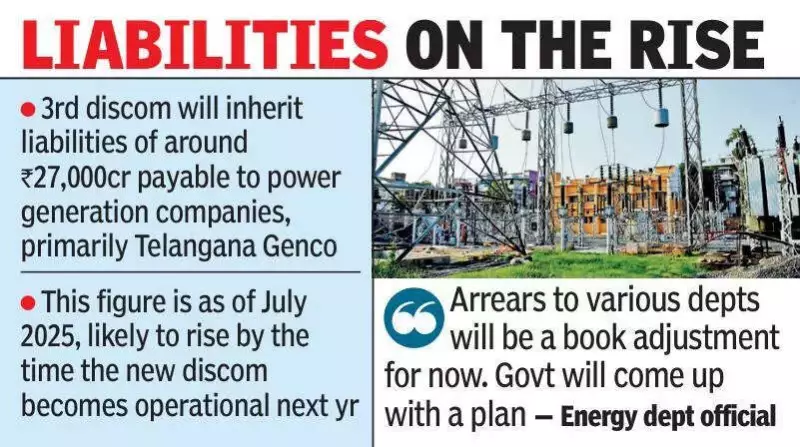
Furthermore, the third discom will inherit substantial liabilities of around ₹27,000 crore payable to power generation companies, primarily Telangana Genco. These figures are current as of July 2025 and are expected to increase by the time the new discom becomes operational next year.
An energy department official stated that the arrears and dues will be handled as a book adjustment for now, and the government will formulate an action plan to address them. This comprehensive move towards smart metering at the transformer level represents Telangana's attempt to gain control over its power finances while navigating the complex politics of agricultural subsidies.