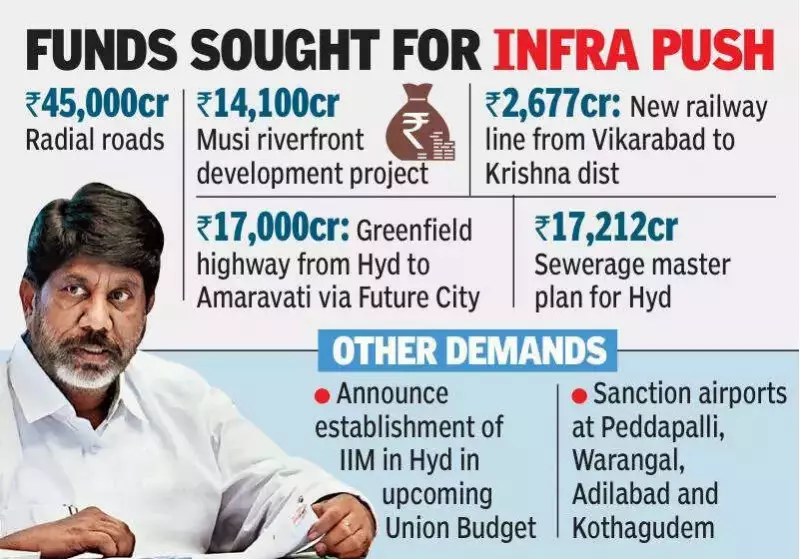
Telangana Deputy Chief Minister Mallu Bhatti Vikramarka has made a strong pitch to the Central government, urging it to declare the Palamuru Ranga Reddy Lift Irrigation Scheme (PRLIS) as a national project in the upcoming Union Budget for 2026-27. He also pressed for crucial funding for major infrastructure initiatives in the state, including the second phase of the Hyderabad Metro Rail and the Regional Ring Road (RRR).
Key Demands for Infrastructure Development
Vikramarka presented these demands during a crucial pre-budget consultation meeting of all state finance ministers, chaired by Union Finance Minister Nirmala Sitharaman in New Delhi on Saturday. He specifically requested the Centre to sanction the pending Hyderabad Metro Rail phase-2 project, which is currently with the Ministry of Urban Development.
The Deputy CM highlighted that both Chief Minister A. Revanth Reddy and he had personally met Prime Minister Narendra Modi, Union Minister Nitin Gadkari, and Sitharaman to discuss these projects. He further asked the Centre to sanction a semiconductor project under the India Semiconductor Mission, arguing that Telangana possesses all the necessary ecosystem for such an industry. Land for this project has already been identified near Thatiparthy village in Ranga Reddy district. Additionally, he sought approval for an Electronics Manufacturing Cluster 2.0 for the state.

Concerns Over Fiscal Transfers and Central Funds
Shifting focus to fiscal policy, Vikramarka raised significant concerns regarding the Centre's approach to Finance Commission recommendations. He stated that while examining the 15th Finance Commission report, the Centre departed from the established tradition of treating its recommended fiscal transfers as a binding award.
"For the first time, the Centre broke this tradition by not accepting the state-specific and sector-specific grants recommended by the Finance Commission," he said. According to his statement, this move resulted in a substantial financial loss for Telangana. The state lost Rs 2,362 crore in state-specific grants and another Rs 3,024 crore in sector-specific grants.
He appealed to Sitharaman to accept all recommendations of the upcoming 16th Finance Commission relating to fiscal transfers as a complete package. Vikramarka also pointed out that the share of cesses and surcharges in the Centre's gross tax revenue has reached 20%. Consequently, even though the 15th Finance Commission recommended a 41% share of tax devolution to states, they are only receiving about 30% of the gross tax revenue.
He proposed a solution: "The total surcharges, amounting to Rs 1,55,000 crore (2025-26 budget estimates), should be credited to a non-lapsable infrastructure fund, from which states can be given grants for infrastructure development." Alternatively, he suggested merging the entire amount of surcharges with basic tax rates to enhance the divisible pool of central taxes.
Criticism of Changes to Rural Employment Scheme
Vikramarka also criticized the Central government's handling of the rural employment guarantee scheme. He stated that the Mahatma Gandhi National Rural Employment Guarantee Act (MGNREGA) was replaced with a new scheme without any consultation with the states.
He explained that MGNREGA was a demand-based program where providing work was a legal guarantee. "In the new Act, the funding pattern was changed from 90:10 (Centre:State) to 60:40, thus imposing a further burden on the already strained resources of states," the Deputy Chief Minister argued. This shift significantly increases the financial liability of state governments in implementing the crucial rural jobs program.
The demands put forth by Telangana's deputy chief minister set the stage for the state's expectations from the forthcoming Union Budget, emphasizing infrastructure, fair fiscal devolution, and support for key employment and industrial policies.