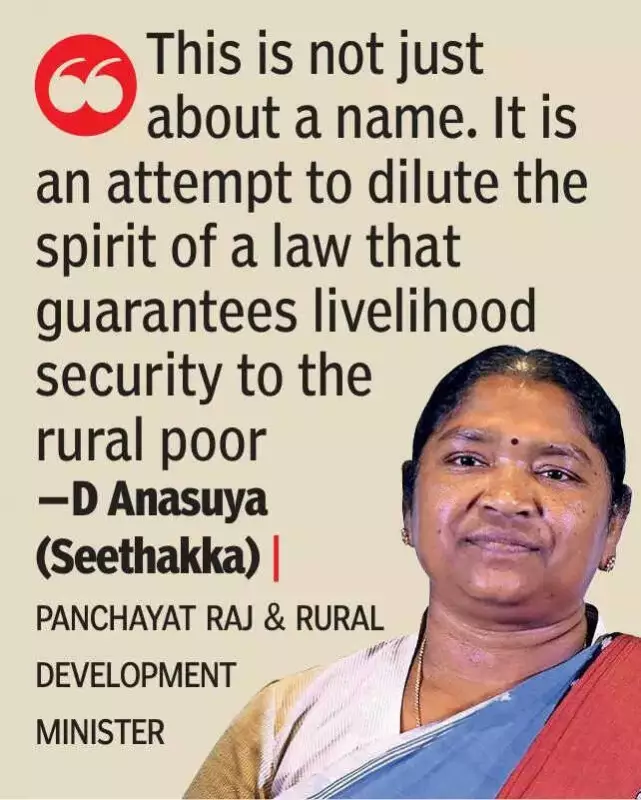
In a significant move, the Telangana government has initiated a statewide campaign to protect the Mahatma Gandhi National Rural Employment Guarantee Scheme (MGNREGS). The state's Panchayat Raj and Rural Development Minister, D Anasuya, popularly known as Seethakka, made the announcement on Monday, outlining plans to pass resolutions in every village and send them to the Central government.
Minister Accuses Centre of Systematic Weakening
Addressing a press conference, Minister Anasuya launched a sharp critique against the BJP-led government at the Centre. She alleged a systematic effort to weaken the foundational Employment Guarantee Act. One of the key points of contention she highlighted was the removal of Mahatma Gandhi's name from the scheme. "This is not just about a name. It is an attempt to dilute the spirit of a law that guarantees livelihood security to the rural poor," Anasuya stated emphatically.
She warned that any move to repeal or significantly weaken the Act would have severe consequences, potentially pushing millions of labourers back into exploitative working conditions and depriving them of a legal right to work.

Planned Protests and Core Concerns
To mobilise public opinion and demonstrate widespread support for the scheme, the minister announced that rallies would be organised across the state on December 27 or 28. Beyond the symbolic issue of the name, Anasuya flagged more tangible threats to the programme.
She pointed to a steady reduction in the number of workdays provided under MGNREGS. "Cutting workdays is effectively denying people their right to earn a livelihood in their own villages," she argued. She expressed concern that diluting the Act would leave rural workers at the mercy of private contractors who offer measly wages, stripping them of the dignity and financial security that MGNREGS provides.
Echoes from the Past: A Scheme Born as a 'Festival'
Supporting the minister's stance, CWC member and former IAS officer Koppula Raju spoke about the historical and emotional significance of MGNREGS. He stated that the removal of Mahatma Gandhi's name had deeply hurt public sentiment. Raju alleged a clear attempt to weaken a programme that has created durable community assets, ensured the dignity of labour, and directly benefited the poorest sections of society. He framed it as part of a larger effort to erase the legacy of national leaders like Nehru and Gandhi.
Recalling the scheme's launch, Raju provided specific details: MGNREGS was announced in September 2005 and officially launched on February 2, 2006, in Anantapur district. "I had the opportunity to organise it as a festival for the poor," he reminisced. He noted that the scheme was implemented extensively under the then chief minister of united Andhra Pradesh, Y S Rajasekhara Reddy. Even after nearly two decades, Raju asserted, the relevance of MGNREGS remains undiminished for India's rural economy.
The Telangana government's initiative sets the stage for a renewed political debate on the future of one of the world's largest social welfare programmes, positioning the state in direct opposition to the Central government's perceived approach.