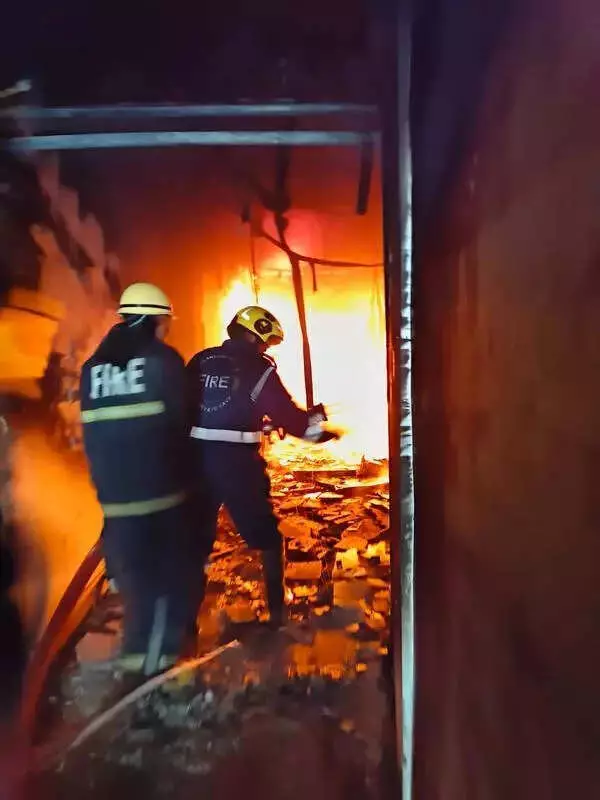
In a significant move to tackle the rising number of fire accidents, the Telangana Fire Services Department has proposed comprehensive amendments to the outdated Fire Services Act (FSA) of 1999. The changes aim to bring a vast number of previously unregulated low-rise buildings under the safety net, addressing a critical gap in the state's urban fire safety framework.
Closing the Regulatory Gap for Low-Rise Structures
The existing Act only regulated buildings taller than 15 metres (roughly five floors), and public places and schools above 6 metres. This left lakhs of buildings below 15 metres, which form the majority of structures in Hyderabad and across Telangana, outside the fire department's purview. Officials state that a majority of fire incidents actually occur in these smaller buildings due to old wiring, overloading, and unsafe practices.
"Due to this existing provision, a vast number of buildings below 15 metres, where fire incidents are more frequent, remained outside our purview," explained a senior fire department officer. The proposed amendment seeks to change this by bringing various categories of sub-15-metre buildings under regulation.

Once amended, apart from residential buildings, hotels, lodges, business, mercantile, and industrial structures, mixed occupancies, and all hazardous buildings as defined by the National Building Code (NBC) will come under the fire department's ambit, particularly if any floor area exceeds 300 square metres.
New Systems: Third-Party Audits and Safety Managers
To implement this without excessive bureaucratic interference, the department plans to introduce a third-party fire safety auditing system for mandatory No-Objection Certificates (NOCs) for buildings below 15 metres. Qualified auditors, including ex-fire service personnel and certified engineers, will be empanelled for this task.
For high-rise buildings already covered under the Act, the amendment makes it mandatory to appoint qualified fire safety managers. Their responsibilities will include maintaining fire protection systems and ensuring escape routes are clear. Building management or owners' associations will bear the cost of appointing these managers.
Addressing a root cause of fires, the department also plans to insist on certification from qualified electrical engineers as part of the compliance mechanism, to be verified through third-party audits. This follows recent major fires in Gulzar Houz and Chandanagar linked to short circuits.
Sharper Teeth: Hefty Fines and Sealing Powers
The amendment proposes a substantial hike in penalties, which were previously nominal. Fines are proposed to jump from Rs 5,000 to at least Rs 50,000, going up to Rs 3 lakh, along with imprisonment. The penalties will be graded based on the outcome: causing grievous injury could lead to up to 3 years in jail, and death up to 5 years with a fine of up to Rs 5 lakh.
Furthermore, the fire department will be empowered to declare buildings unsafe and seal premises that pose an imminent fire risk, a power previously held largely by municipal authorities.
Resident Welfare Associations React with Caution
While welcoming the intent, Resident Welfare Associations (RWAs) have expressed cautious optimism and called for practical implementation. BT Srinivasan, General Secretary of United Federation of RWAS (U-FERWAS), supported the move, noting that in cramped low-rise apartments without lifts, emergency mobility is difficult and basic safety equipment is crucial.
However, Dr. Sai Ravi Shanker, President of the Cyberabad Gated Community Association, urged authorities to streamline the NOC process and issue clear SOPs. He highlighted the challenge for existing standalone apartments, where 99% are already built, often with no space for fire brigade access. Key systems like internal hose pipelines are difficult to retrofit.
"To keep a fire safety manager will add financial burden on middle-income communities," he said, calling for a practical and affordable approach with clarity on alternatives where full compliance is not feasible.

The amendment proposal, reportedly sent to the state government in 2022, is now back in focus. If approved, it will apply across Telangana and be rolled out in coordination with urban local bodies like the GHMC. Occupancy certificates for new buildings will depend on inspections by fire officers to ensure adequate fire-fighting equipment is in place.