Telangana Calls for KRMB Intervention Against Andhra's Unauthorized Water Projects
In a significant development concerning the ongoing Krishna River water dispute, the Telangana government has urgently appealed to the Krishna River Management Board (KRMB) to take decisive action against neighboring Andhra Pradesh. The state has demanded that the KRMB restrain Andhra Pradesh from initiating any unauthorized irrigation projects or expanding existing ones without obtaining mandatory approvals from the board, the Central Water Commission (CWC), and the Apex Council.
Allegations of Unauthorized Enhancements and Violations
Telangana has raised serious concerns about Andhra Pradesh allegedly enhancing the drawal capacity of the Pothireddypadu head regulator and increasing the carrying capacity of the Srisailam right main canal. Furthermore, the state has accused Andhra of upgrading the Banakacherla cross regulator and expanding the associated canal system that conveys water to the Pennar basin. These actions, according to Telangana, have been undertaken without due appraisal, recommendation, or approval as mandated under the AP Reorganisation Act of 2014.
In a recent letter addressed to the KRMB, Telangana's Engineer-in-Chief OV Ramesh Babu emphasized that the board must prevent Andhra Pradesh from drawing water until the Krishna Water Disputes Tribunal (KWDT)-II finalizes the water shares. The state maintains that these issues have already been thoroughly deliberated before the board, the Apex Council, and the tribunal.

Accusations of Misleading Claims and NGT Order Violations
Telangana has also requested the KRMB to stop Andhra Pradesh from making what it describes as misleading allegations against Telangana's own irrigation projects. These projects are specifically designed to serve drought-prone and backward riparian areas within the state.
Adding to the grievances, Telangana pointed out that despite clear orders from the National Green Tribunal (NGT), Andhra Pradesh is proceeding with the Rayalaseema Lift Irrigation Scheme (RLIS). The state expressed frustration that the KRMB has not taken appropriate action in this regard. "Telangana government wrote multiple letters to KRMB and the Ministry of Jal Shakti on RLIS. But no effective intervention either by KRMB and Jal Shakti Ministry was taken," stated Engineer-in-Chief OV Ramesh Babu.
Expanded Project Scope and Future Demands
Telangana further contended that Andhra Pradesh has already expanded the scope of several key projects, including Handri Neeva, Galeru Nagari, Telugu Ganga, Veligonda, and the Srisailam right branch canal. These expansions are reportedly utilizing approximately 114 thousand million cubic feet (tmcft) of water.
Moreover, the state alleged that Andhra has projected additional future demands of around 176 tmcft under contemplated projects, which involve diverting water outside the Krishna River basin. Telangana insists that the KRMB must bring these alleged violations to the attention of the Central Government and ensure strict compliance with statutory norms governing irrigation projects on the Krishna River.
Irrigation Minister Highlights Siltation Crisis
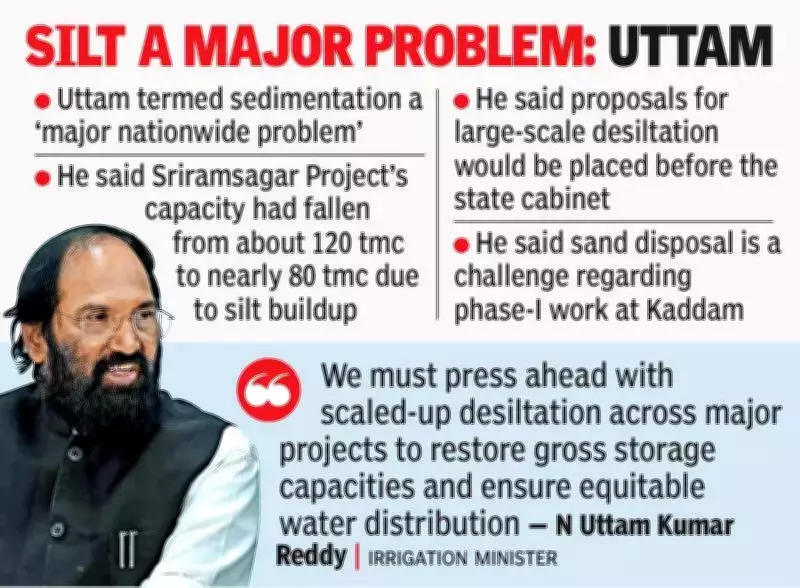
In a related development, Telangana's Irrigation Minister N Uttam Kumar Reddy has called for the immediate implementation of Phase-II desiltation across major irrigation projects. This initiative aims to restore lost storage capacity and secure water for farmers who are grappling with persistent sedimentation issues.
During a review meeting with officials and farmers from the SRSP Stage-II ayacut districts, Minister Reddy described sedimentation as a major nationwide problem. He highlighted that the Sriramsagar Project's capacity has drastically declined from about 120 tmc to nearly 80 tmc due to decades of silt buildup.
"We must press ahead with scaled-up desiltation across major projects to restore gross storage capacities and ensure equitable water distribution," Minister Reddy asserted. He mentioned that proposals for large-scale desiltation would be presented to the state cabinet, and he plans to discuss tail-end irrigation concerns with Chief Minister A Revanth Reddy.

Referring to the Phase-I desiltation works at Kaddam, which utilized modern dredging techniques, the minister acknowledged that sand disposal remains a significant challenge. The state is committed to advancing these efforts to address the critical issue of siltation and safeguard water resources for agricultural and domestic needs.