In a significant development, Telangana Chief Minister A Revanth Reddy has declared that the state government will order a comprehensive inquiry into the controversial shifting of the source for the Palamuru-Rangareddy Lift Irrigation Scheme (PRLIS). The probe will follow a detailed debate in the state assembly scheduled for the coming days.
Allegations of Deep-Rooted Corruption
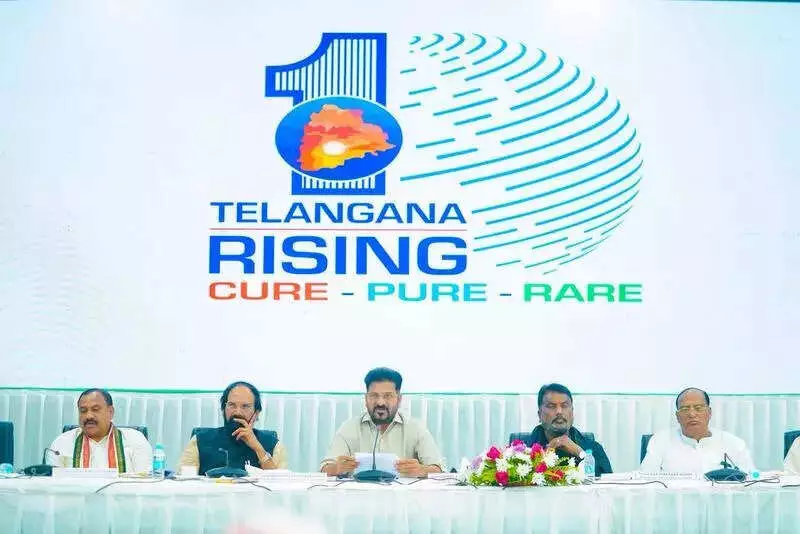
The Chief Minister, speaking during a PowerPoint presentation at Praja Bhavan in Hyderabad on Thursday, leveled serious allegations of corruption. He stated that the previous Bharat Rashtra Samithi (BRS) government's decision to move the project's source from the Jurala project to Srisailam was marred by malpractice. Revanth Reddy specifically pointed to the change in location, the increase in the number of lifts and pumps, and the massive escalation in the project's cost as areas of concern.
Drawing a parallel with the Kaleshwaram project controversy, the CM noted that both projects involved unauthorized shifts in source location. "The Kaleshwaram source was shifted from Thummidihatti to Medigadda without cabinet approval, and it was found fault by the Justice PC Ghose commission, which said it was an individual decision. In the PRLIS project issue also, the project source was shifted from Jurala to Srisailam, without cabinet nod," he explained.
Key Questions and a Political Challenge
Revanth Reddy outlined the focus of the proposed investigation. The inquiry will seek to determine for whose benefit the source was changed, who received commissions, and the reasons behind the project estimate ballooning from ₹32,000 crore to a staggering ₹80,000 crore. He also criticized the BRS for not submitting a Detailed Project Report (DPR) for seven years after conceiving the Palamuru project, during which time the number of pumps increased from 22 to 37 and the water lifting stages were revised from three to five.
Turning his attention to BRS president and former CM K Chandrasekhar Rao (KCR), Revanth Reddy accused him of raking up Telangana sentiment for political survival after a series of electoral defeats. He issued a direct challenge, inviting KCR, as the Leader of the Opposition, to participate in the assembly debate on PRLIS and Krishna water issues. "I assure KCR that he will be treated with respect and will be given sufficient time to present his arguments," the CM said, adding that KCR could also submit his suggestions in writing if he preferred not to attend the House.
Technical Flaws and Water Rights Dispute
The Chief Minister provided a technical rationale against the source shift. He argued that Jurala, being within Telangana, allowed the state to draw 90 thousand million cubic feet (tmc ft) of water over 30 days (3 tmc ft daily) without issue. In contrast, Srisailam is a common project with other states having rights. He highlighted that the Andhra Pradesh government is currently diverting 13.5 tmc ft daily from Srisailam, while Telangana struggles to draw even 2.5 tmc ft.
He dismissed the BRS's justification for the shift—that Jurala had only 9 tmc ft of water versus 300 tmc ft at Srisailam—as "absurd." Reddy asserted that if PRLIS drew water from Jurala, it would prevent Andhra Pradesh from illegally utilizing the 13.5 tmc ft for its projects.
In a sharp critique of former irrigation minister T Harish Rao, the CM alleged that Harish Rao shifted his focus to the Godavari link projects like Bankacherla and Nallamala Sagar upon sensing that an inquiry with specific Terms of Reference (TOR) was being prepared. Revanth Reddy also held KCR responsible for signing a "death warrant" by agreeing to an allocation of 299 tmc ft of water for Telangana and 512 tmc ft for Andhra Pradesh at an Apex Council meeting in 2020.
The announcement sets the stage for a major political and administrative confrontation in Telangana, centering on irrigation projects, alleged corruption during the BRS tenure, and the complex inter-state dispute over Krishna river waters.