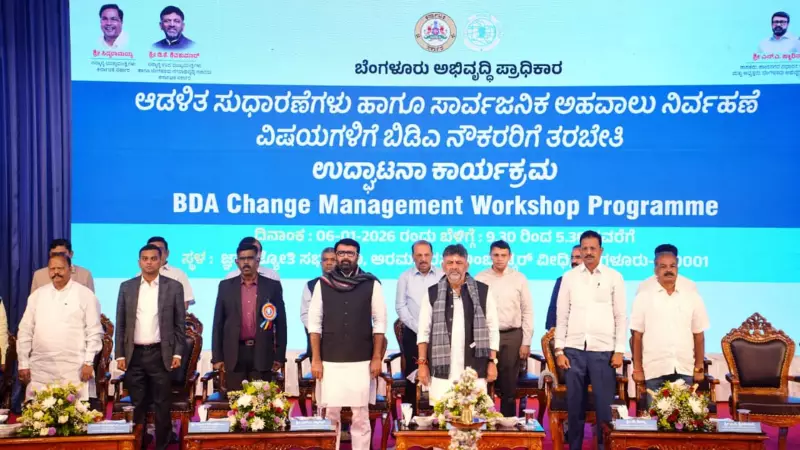
Karnataka Deputy Chief Minister and Bengaluru Urban Development Minister D K Shivakumar has issued a stern warning against corruption within the Bengaluru Development Authority (BDA), stating he possesses specific intelligence on malpractices and is determined to overhaul the organization's public image.
Six-Month Probe Reveals Systemic 'Rot'
Speaking at a governance workshop for BDA employees on Tuesday, January 7, 2026, Shivakumar revealed that a six-month internal investigation based on his "own intelligence inputs" had exposed deep-seated corruption. He attributed the BDA's tarnished reputation to a minority of its workforce, alleging that around 10 per cent of employees are corrupt.
"I am aware of the rot in the system at every stage," the Deputy CM asserted. He emphasized that this misconduct by a few was unfairly giving the entire organization a bad name. In response, Shivakumar announced a decisive move towards complete transparency: the digitisation of all BDA documents. "Some may not like this, but we have to change BDA," he stated, acknowledging potential resistance to the reform.
A Direct Appeal for Discipline and Public Service
Shivakumar framed the BDA and the Greater Bengaluru Authority (GBA) as the face of India's tech capital. He called for a fundamental shift in attitude, urging employees to focus on solving citizens' problems rather than creating them. "What this city needs today is discipline and honesty. Instead of red-taping the files, identify the mistakes constructively and find solutions," he advised.
His message was clear and direct: employees must work within the legal framework to assist the public. "Find a solution within the legal framework, don't trouble the people," he reiterated, warning that he would not be lenient on corruption and would take strict action against those found guilty.
Broader Urban Planning Challenges for a Growing Bengaluru
Expanding on the city's development woes, Shivakumar highlighted critical planning failures. He noted that Bengaluru's population has ballooned to 1.4 crore (14 million), for which the city was unprepared. He lamented the lack of planned areas beyond older localities like Jayanagar, Malleshwaram, and Chamarajapet.
To address the infrastructure deficit, he reaffirmed the government's commitment to the Bengaluru Business Corridor, a project he vowed to complete despite opposition. He cited the massive cost escalation of the peripheral ring road—from an estimated Rs 26,000 crore in 2010 to Rs 50,000 crore now—as a cautionary tale of delay. "We have worked out a different plan to reduce the costs," he said, adding firmly that not "even an inch of land" would be de-notified for the project.
Furthermore, to professionalize town planning, Shivakumar announced the establishment of a dedicated Town Planning College in Bengaluru. This aims to curb the current practice of engineers from unrelated disciplines entering the Town Planning Department, which he implied contributed to haphazard urban growth.