
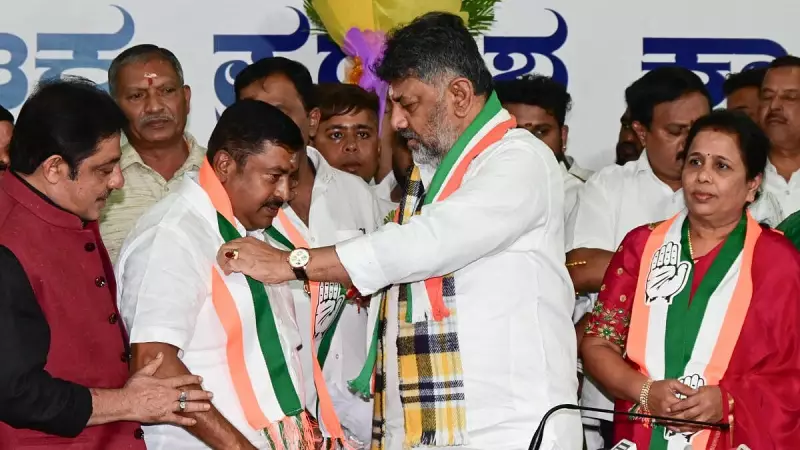
In a significant political commentary, Karnataka Deputy Chief Minister and Congress leader DK Shivakumar has stated that the proposed merger of the Janata Dal (Secular) with the Bharatiya Janata Party (BJP) will ultimately benefit the Congress in the state. He framed the development as a simplification of the political battlefield.
Shivakumar's Strategic Advice to JD(S)
Speaking on January 8, 2026, Shivakumar directly addressed the leaders of the JD(S). He advised them against engaging in what he termed a "friendly fight" with their alliance partner, the BJP. "Please, don't have a friendly fight. Join together," he said, suggesting that such internal confusion would only demoralize their party workers and create uncertainty among the electorate.
His remarks highlight the internal dynamics of the opposing alliance. Shivakumar implied that a clear merger is preferable to a shaky coalition where both parties might still compete for the same political space and voter base, leading to a split in anti-Congress votes.
The 'Two vs. One' Political Calculus
The core of Shivakumar's argument lies in his assessment of the political landscape. He reduced the complex scenario to a straightforward equation: "Three parties on paper, but only two really count." This statement underscores the Congress's perspective that a formal union between the JD(S) and the BJP effectively consolidates the opposition into a single, identifiable bloc.
From the Congress's viewpoint, this consolidation makes the electoral contest clearer for voters. Instead of a fragmented opposition with multiple choices, it becomes a direct fight between the Congress and the united BJP-JD(S) combine. This, the Congress believes, allows them to position themselves as the primary alternative more effectively.
Implications for Karnataka's Political Future
The deputy chief minister's public analysis is more than mere commentary; it is a strategic messaging effort aimed at both the public and political cadres. By confidently stating that the merger helps his own party, Shivakumar aims to project strength and clarity within the Congress ranks. The message to Congress workers is one of opportunity rather than threat.
Furthermore, his "advice" to the JD(S) serves to publicly highlight the potential fissures and leadership dilemmas within the rival camp. It puts pressure on the JD(S) leadership to fully commit to the alliance, knowing that any visible discord will be seized upon by the Congress. This move is calculated to influence the narrative in the lead-up to future electoral battles in Karnataka.
The developments of January 2026 set the stage for a polarized political environment in the state. As alliances crystallize, the battle lines are being drawn for a direct confrontation, which the Congress leadership, as per Shivakumar's statements, seems ready to embrace.