Sasikala's Political Comeback: Banking on Amma's Legacy in Tamil Nadu
In the intricate landscape of Tamil Nadu politics, memory transcends mere emotion—it serves as a powerful currency. Among these memories, none holds more weight than that of J Jayalalithaa, the late AIADMK supremo revered as "Amma." Her political legacy continues to shape electoral strategies nearly a decade after her passing, influencing voter behavior and party dynamics.
The Amma Legacy: Welfare and Emotional Politics
Under Jayalalithaa's leadership, governance in Tamil Nadu was meticulously crafted as a blend of welfare delivery and emotional politics. Subsidies accounted for over a third of the state's revenue expenditure, forming the backbone of a populist model that deeply resonated with women, rural voters, and lower-income households. Her administration was marked by progressive social interventions, such as making Tamil Nadu the first Indian state to allow government hospitals to perform medical procedures for transgender individuals to combat infections. This move was widely seen as progressive within a traditionally conservative environment.
From subsidised goods to targeted welfare schemes, the state's administrative machinery often functioned as an extension of Amma's personal brand. This direct linkage between leader and beneficiary created an unusually strong emotional voter contract, one that still influences political behavior today. It is this legacy that former AIADMK chief VK Sasikala is attempting to tap into, not just politically but emotionally, as she launches her new outfit, the All India Puratchi Thalaivar Makkal Munetra Kazhagam.

From Power Centre to Political Outsider: Sasikala's Journey
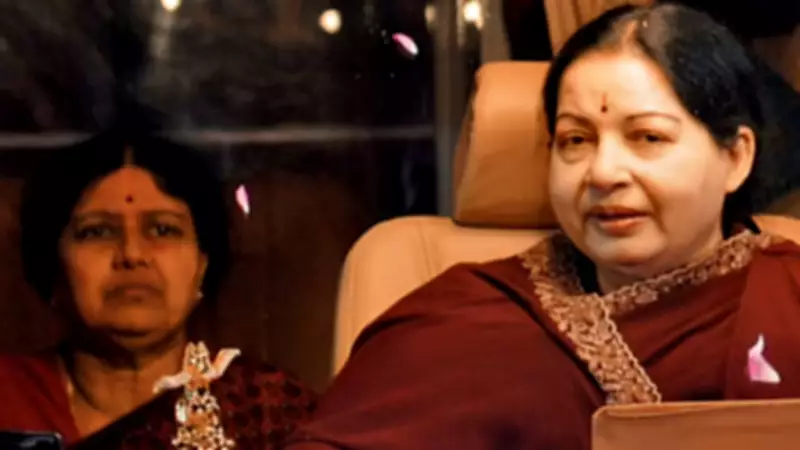
Sasikala's political narrative is inextricably linked to Jayalalithaa's inner circle. Known as "Chinnamma," she served for decades as a powerful intermediary within the AIADMK ecosystem, controlling access to leadership and influencing cadre-level decisions without holding formal office. Introduced into the party orbit in the early 1980s, she became a constant presence at Jayalalithaa's Poes Garden residence, evolving from confidante to gatekeeper.
After Jayalalithaa's death in 2016, Sasikala was unanimously elevated as AIADMK general secretary during a leadership vacuum, briefly positioning her as the party's central authority. However, her political trajectory quickly unraveled, leading to fragmentation within the AIADMK. Competing factions led by EPS and OPS emerged, eventually merging but failing to restore the earlier emotional unity. The party transformed from a tightly controlled cadre machine under Jayalalithaa into a negotiated coalition of leaders, where authority is distributed rather than centralised.
Can Amma's Emotional Capital Be Transferred?
Sasikala's current strategy hinges on the assumption that Amma's emotional capital can be transferred to her leadership project. However, Tamil Nadu's political history suggests otherwise. Jayalalithaa's appeal was deeply personal and centralised, creating a direct leader-to-voter relationship that bypassed intermediaries. Sasikala, despite her proximity, was always an enabler, not the face of that contract. This distinction poses a core challenge to her political revival.
AIADMK's Countermove: Reinforcing Amma's Memory
Wary of the growing "Sasikala factor," the AIADMK leadership has moved to reassert Jayalalithaa's monopoly over political memory. Senior leader Edappadi K Palaniswami called on cadres ahead of Jayalalithaa's birth anniversary to take a pledge in her name. Cadres were instructed to light lamps at 6 pm in their homes, pray to Amma's "atma," and vow to protect the party till their last breath. This spiritual-political exercise, framed as a defense against "enemies and betrayers," serves as a pre-emptive mobilisation against internal and external challengers like Sasikala.

DMK's Consolidation: Governance Over Nostalgia
Simultaneously, the ruling Dravida Munnetra Kazhagam under Chief Minister MK Stalin has consolidated its position through welfare expansion, institutional governance, and cadre stability. Unlike personality-driven mobilisation, the DMK's strategy relies on scheme-based outreach and bureaucratic delivery systems that reduce dependence on emotional recall. The entry of O Panneerselvam into the DMK camp marks a significant shift, as he leverages the emotional weight of the Amma legacy in a new alliance ahead of the 2026 elections.
A Crowded Opposition: Fragmentation and Challenges
The political battlefield has been further reshaped by the entry of actor-politician Vijay through Tamilaga Vettri Kazhagam, turning what was once a bipolar contest into a multi-polar field. This fragmentation disperses anti-incumbency sentiment across multiple challengers, reducing the likelihood of any single opposition force converting emotional appeal into electoral dominance. Sasikala's campaign heavily leans on Jayalalithaa-era symbolism, but political observers note a critical gap: symbolism does not automatically translate into cadre mobilisation.
Jayalalithaa's rallies were defined by precision and command, turning emotion into electoral machinery, whereas Sasikala's current style lacks the same disciplined mass orchestration. Additionally, her return is framed by ongoing legal and political aftershocks, including civil suits challenging AIADMK decisions and state-level actions related to disproportionate assets investigations, which cast a shadow over her political rehabilitation.
The Central Question: Memory vs. Machinery
There is no doubt that Amma nostalgia continues to influence Tamil Nadu's political psyche, visible in welfare memory and symbolic politics. However, nostalgia alone is not a standalone vote bank; it requires organisational depth, leadership credibility, and electoral machinery to convert sentiment into seats. For Sasikala, the challenge is not merely invoking Amma's legacy but proving she can operate outside it. The AIADMK invokes Amma to protect itself, the DMK counters through governance, and Sasikala attempts to claim it as an inheritance. In between lies the central question of Tamil Nadu politics today: can memory survive without machinery, and can machinery be rebuilt from memory alone?