RLD Legislator's Housing Query Triggers Fiery Assembly Exchange in Jaipur
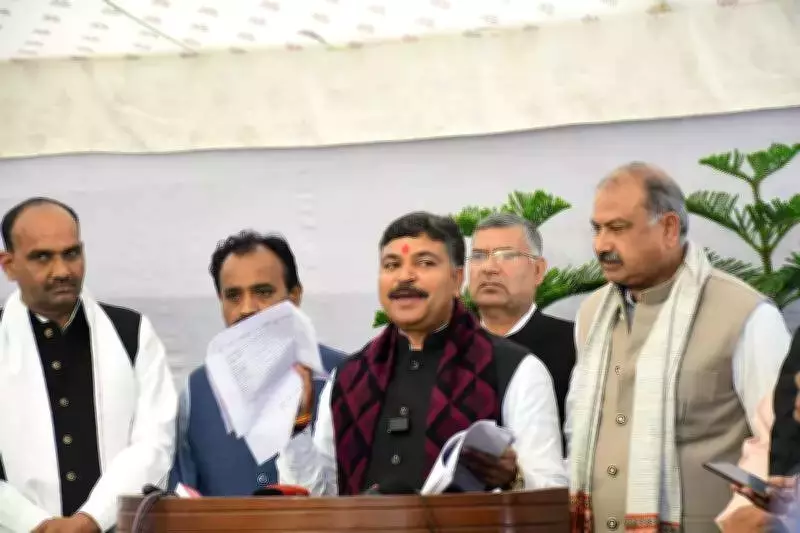
In a dramatic session at the Rajasthan Legislative Assembly in Jaipur, Rashtriya Lok Dal (RLD) legislator Subhash Garg ignited a nearly 15-minute-long heated confrontation between Treasury and Opposition benches during Wednesday's Question Hour. The flashpoint emerged when Garg raised pressing concerns regarding housing provisions for houseless families in the Bharatpur district, exposing deep political divisions over welfare implementation.
Minister's Response and the Definition Debate
Responding to the legislator's inquiry, Urban Development and Housing (UDH) Minister Jhabar Singh Kharra presented statistics indicating that approximately 80% of houses sanctioned under the Pradhan Mantri Awas Yojana (PMAY) in Bharatpur had reached completion. However, the discussion rapidly shifted from numerical data to a fundamental semantic dispute about the very definition of "houseless" families, with Opposition members accusing the minister of deliberately misinterpreting the term to obscure ground realities.
The Core of the Controversy
The controversy originated when MLA Subhash Garg demanded specific details about:

- The exact number of houseless families identified in Bharatpur district
- The count of eligible beneficiaries under the PMAY housing scheme
Dissatisfied with the minister's initial response, Garg insisted that the government must first transparently disclose the actual number of houseless families rather than elaborating on eligibility criteria under the scheme. This insistence triggered repeated interruptions from both sides of the aisle, escalating into a prolonged verbal duel that disrupted parliamentary decorum.
Semantic Distinction: Homeless vs. Houseless
Defending the government's position, Minister Kharra attempted to draw a technical distinction between "homeless" and "houseless" families. He asserted, "A family without land cannot be termed houseless. A person becomes houseless only when land is available. Those without land are homeless, while those who have land but no house are houseless." The minister further offered to obtain a detailed report from the district collector regarding landless families and present it before the House, a proposal that failed to placate the agitated Opposition.
Opposition's Counter-Argument
Leader of Opposition Tikaram Jully intervened forcefully, clarifying that the original question specifically addressed "awash-hin" (houseless) families and that confusion had been unnecessarily introduced by linking it to homeless policy. Jully pointedly questioned, "The question is simple—when will those who do not have houses be given houses?" He directly alleged that the government's reply was fundamentally incorrect and designed to evade accountability.
Political Implications and Broader Context
The repeated interruptions and sharp exchanges created disorderly scenes in the legislative chamber, highlighting the persistent political friction between Rajasthan's ruling party and Opposition regarding housing policy and welfare measure implementation. This incident underscores how technical definitions can become political battlegrounds, with vulnerable populations' housing needs caught in bureaucratic and semantic crossfire. The debate reveals deeper tensions about transparency in scheme implementation and the government's responsiveness to legislators' concerns about marginalized communities in districts like Bharatpur.