Congress Leader Sounds Alarm on Punjab's Deepening Financial Crisis
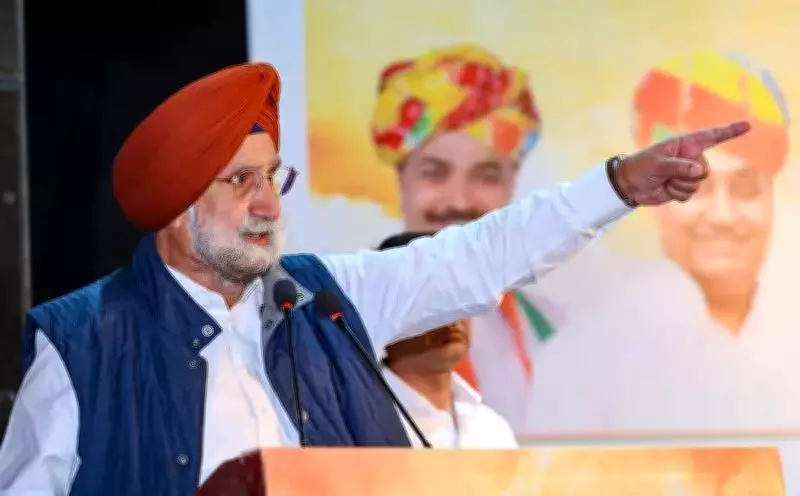
In a stark warning issued on Tuesday, Congress leader and Gurdaspur MP Sukhjinder Singh Randhawa expressed grave concern over the deteriorating financial health of Punjab. Citing the latest Comptroller and Auditor General of India (CAG) report, Randhawa asserted that under the Aam Aadmi Party government, the state is continuously sinking into a debt trap, with critical economic indicators showing alarming trends.
Doubling Fiscal Deficit and Soaring Debt Burden
Randhawa, who previously served as Deputy Chief Minister of Punjab, highlighted that the state's fiscal deficit has doubled from Rs 14,285 crore in the 2019-20 fiscal year to Rs 28,215 crore in 2023-24. This sharp increase underscores a failure to generate adequate revenue sources, leading to a widening gap between income and expenditure. Concurrently, Punjab's debt has surged from Rs 1.62 lakh crore in 2019-20 to Rs 2.08 lakh crore in 2023-24, and it has now reached an estimated Rs 4.17 lakh crore in the current year. At this accelerating pace, Randhawa cautioned that the debt could balloon to Rs 5 lakh crore by year-end, posing severe risks to the state's economic stability.
Subsidies as a Major Financial Pressure Point
The senior Congress leader pointed out that subsidies have become a significant drain on Punjab's finances, nearly doubling from Rs 10,161 crore in 2019-20 to Rs 18,770 crore in 2023-24. Of this total, approximately 92-99% has been allocated to electricity subsidies, indicating a heavy reliance on populist measures that strain the exchequer without corresponding revenue enhancements. Randhawa emphasized that this unsustainable expenditure pattern exacerbates the fiscal deficit and hampers long-term economic planning.
Call for Bipartisan Financial Oversight and Reform
To address this crisis, Randhawa appealed to Chief Minister Bhagwant Mann to convene an all-party financial discussion aimed at forging a consensus-based strategy for Punjab's economic revival. He proposed the formation of a legislative financial oversight committee comprising members from all political parties. This committee would monitor key areas such as debt management, expenditure quality, and fund utilisation, ensuring transparency and accountability in financial governance.
Randhawa stressed that audit observations from the CAG report should not be reduced to mere political accusations but should serve as warnings for systemic reforms. The report reflects long-standing structural weaknesses in Punjab's financial management, with successive governments sharing responsibility for the current stress. He advocated for institutional accountability mechanisms to prevent future lapses and called for a comprehensive financial transparency framework coupled with a bipartisan reform roadmap.
In conclusion, Randhawa underscored that only collective efforts and a unified approach can resolve Punjab's financial predicament, urging immediate action to safeguard the state's economic future.