Vasundhara Raje Endorses Khejri Bachao Andolan as Protests Intensify in Rajasthan
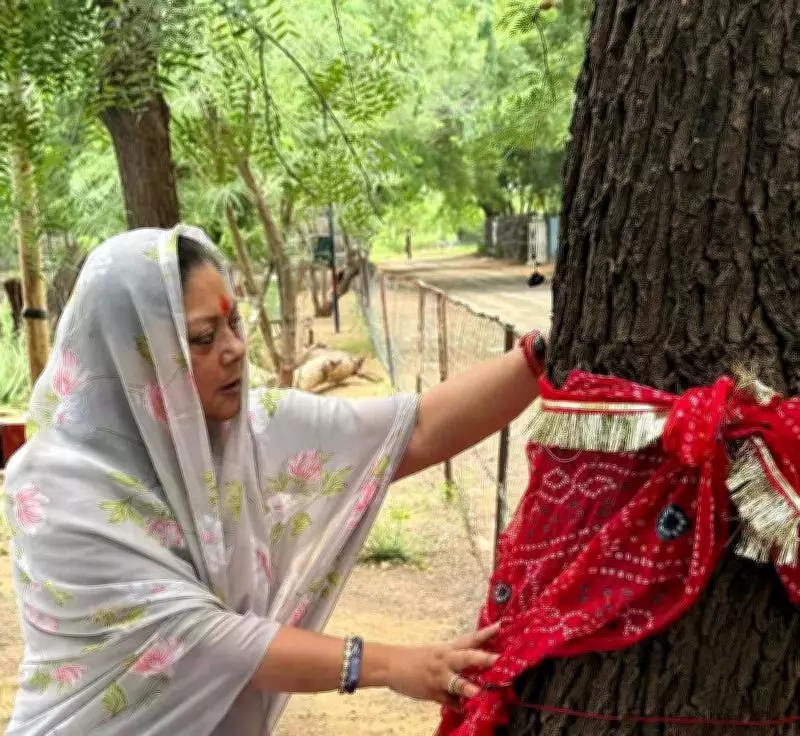
In a significant political development, former chief minister and senior BJP leader Vasundhara Raje has publicly expressed her support for the ongoing Khejri Bachao Andolan, a widespread movement dedicated to protecting Rajasthan's sacred Khejri trees. Raje took to social media on Tuesday to share a photograph of herself worshipping the revered tree, accompanied by a powerful message that transcends political boundaries.
Raje's Spiritual Appeal for Tree Protection
"Khejri is not an ordinary tree; it is our divine tree, intimately linked with our faith and emotions," Raje wrote in her post. She emphasized the deep cultural and religious significance of the Khejri in Rajasthan's traditions, stating, "In our tradition, the Khejri is worshipped, and I offer my prayers. Protecting what we revere is our duty. We must rise above politics to safeguard it." The veteran politician concluded by declaring her solidarity with all individuals and groups committed to preserving both the Khejri trees and the Oran grazing lands that sustain local ecosystems.
Seers Launch Indefinite Hunger Strike in Bikaner
Meanwhile, the agitation to protect Khejri trees in Bikaner district gained substantial momentum as blindfolded seers initiated an indefinite sit-in protest near the Collectorate on Tuesday. The demonstration saw the participation of three hundred sixty-three seers and community members, who united under a common demand: an immediate halt to all tree felling activities until the Tree Protection Act is formally enforced by the state government.

In a dramatic escalation of their protest, several seers and devotees decided to abstain from food indefinitely, transforming the sit-in into a hunger strike. Sant Sachchidanand, one of the leading figures in the movement, articulated their straightforward demand: "Our demand is simple: until the Tree Protection Act is enforced, not a single Khejri tree should be cut."
Political and Administrative Responses
The protest has drawn attention from both political leaders and administrative officials. Former minister Govindram Meghwal called for urgent legislative action, urging Chief Minister Bhajan Lal Sharma to announce in the State Assembly that a law specifically protecting Khejri trees would be enacted within two days. This demand was echoed in the Assembly by Congress MLA Harish Chaudhary from Baytu, who highlighted the ecological and cultural importance of the Khejri.
"In our region, we did not build many stone temples, but we worshipped Khejri trees as deities," Chaudhary stated. "In the arid landscape, our ancestors not only worked tirelessly to preserve vegetation through countless struggles, but also elevated these trees and plants to a divine status, dedicating everything to their protection. Without the Khejri, the very identity of this region remains incomplete." He appealed to the government to respect regional sentiments and enact concrete, sensitive legislation to protect life-giving trees like the Khejri.
On the administrative front, Collector Namrata Vrishni and SP Kavendra Sagar visited the protest site to engage with the demonstrators. They assured the gathering that no Khejri trees in Bikaner would be felled and attempted to facilitate a peaceful conclusion to the demonstration. However, the protesters, guided by the seers, refused to disperse and instead announced the continuation of their indefinite hunger strike.
Heightened Security and Growing Public Support
In response to the escalating situation, the administration deployed a heightened security presence at the Collectorate, including personnel from the Special Task Force (STF) to maintain public order. The protest has already garnered substantial public support, as evidenced by Monday's mahapadav, which attracted a significant crowd from across Rajasthan. Many participants stayed overnight in tents near the Bishnoi Dharamshala, while others maintained a vigil, demonstrating the widespread grassroots backing for the Khejri Bachao Andolan.

As the movement continues to gain traction, it underscores a critical intersection of environmental conservation, cultural heritage, and political activism in Rajasthan. The combined efforts of political figures like Vasundhara Raje, dedicated seers, and local communities highlight a collective determination to safeguard the state's natural and spiritual legacy for future generations.