Rajasthan Deputy CM Diya Kumari Unveils Major Welfare and Infrastructure Initiatives in Budget Debate
In a significant address during the Rajasthan Assembly's budget debate on Tuesday, Deputy Chief Minister and Finance Minister Diya Kumari announced a comprehensive series of welfare and infrastructure measures while launching a sharp critique of the opposition Congress party regarding the state's financial management.
Fiscal Discipline and Public Engagement
Taking direct aim at the previous administration, Kumari stated, "The previous government had emptied the coffers and now lectures us on financial discipline." She provided concrete data to support her claims, revealing that during the Congress regime, the fiscal deficit stood at 4.4% of Gross State Domestic Product (GSDP). In contrast, she announced that the current government has successfully reduced this deficit to an estimated 3.8% for the 2025–26 fiscal year, with plans to further decrease it to 3.69% in FY 2026–27.
Kumari emphasized the government's commitment to public participation in governance, disclosing that nearly 38,000 public suggestions received for the budget were thoroughly examined. Wherever feasible, these suggestions have been incorporated into the FY 2026–27 budget proposals, demonstrating a responsive approach to policymaking.

Infrastructure Development Initiatives
The deputy chief minister outlined several key infrastructure projects designed to enhance connectivity and support industrial growth across Rajasthan. To strengthen road infrastructure, an additional allocation of Rs 690 crore has been designated for the development, repair, and upgradation of both urban and rural roads throughout the state.
Addressing critical water needs in the strategically important Neemrana industrial belt along the Delhi-Mumbai Industrial Corridor, the government has planned a major water management project. This involves constructing an artificial reservoir and feeder system at a cost of Rs 1,012 crore to ensure reliable industrial and drinking water supply to the region.
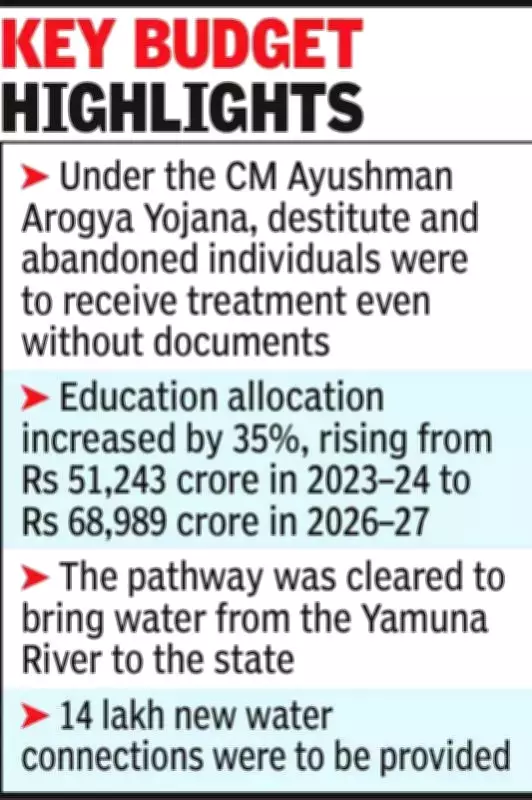
Further water infrastructure investments include Rs 150 crore set aside to replace old and dilapidated pipelines across rural and urban areas of Rajasthan, along with over Rs 210 crore earmarked for new drinking water projects in various regions.
Industrial Development and Employment Generation
In a move to boost regional employment and economic activity, the government has planned a large industrial zone near the under-construction Kota-Bundi Greenfield Airport. This zone, to be developed by the Rajasthan State Industrial Development and Investment Corporation, will host logistics, textile, and other manufacturing units, creating substantial employment opportunities.
To accelerate entrepreneurship and streamline business processes, applications under the MSME (Micro, Small and Medium Enterprises) and ODOP (One District One Product) schemes will now be approved directly by General Managers at District Industries Centres, reducing bureaucratic delays.
For enhanced industrial water sustainability, a Detailed Project Report is being prepared to transport treated water from the Jojari River and the Bandi River through pipelines up to the Pachpadra Refinery, ensuring reliable water supply for industrial operations.
Agricultural and Land Access Reforms
In a significant policy shift benefiting farmers, Kumari announced that agriculturalists will now be able to obtain up to 20 feet of government land allotted for approach roads to their fields. This allocation comes at a cost of twice the prevailing District Level Committee (DLC) rate of agricultural land.
Kumari explained the rationale behind this measure: "Where government land lies between access roads and khatedari land, the absence of approach roads has prevented land use change for non-agricultural purposes. In such cases, a strip of land up to 20 feet wide will be allotted to ensure direct access." This reform is expected to facilitate agricultural development and land utilization.

Social Security and Employee Benefits
Responding to Congress allegations regarding pension disruptions, Kumari clarified that social security pension payments for senior citizens, widows, and persons with disabilities have been cleared up to January 2026, ensuring uninterrupted support to these vulnerable sections of society.
For government employees, she announced several beneficial policy changes. Employees selected for central or other state services during their two-year training period will no longer be required to refund salary and allowances upon resigning from their current posts. Additionally, she announced lifetime insurance coverage for state employees extending up to retirement, providing enhanced financial security.
The comprehensive announcements reflect the Rajasthan government's multi-pronged approach to addressing infrastructure gaps, supporting economic growth, and strengthening social welfare programs while maintaining fiscal discipline.