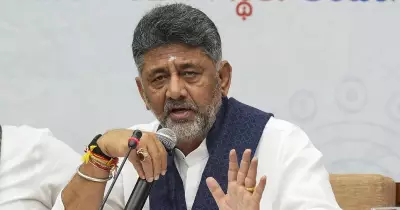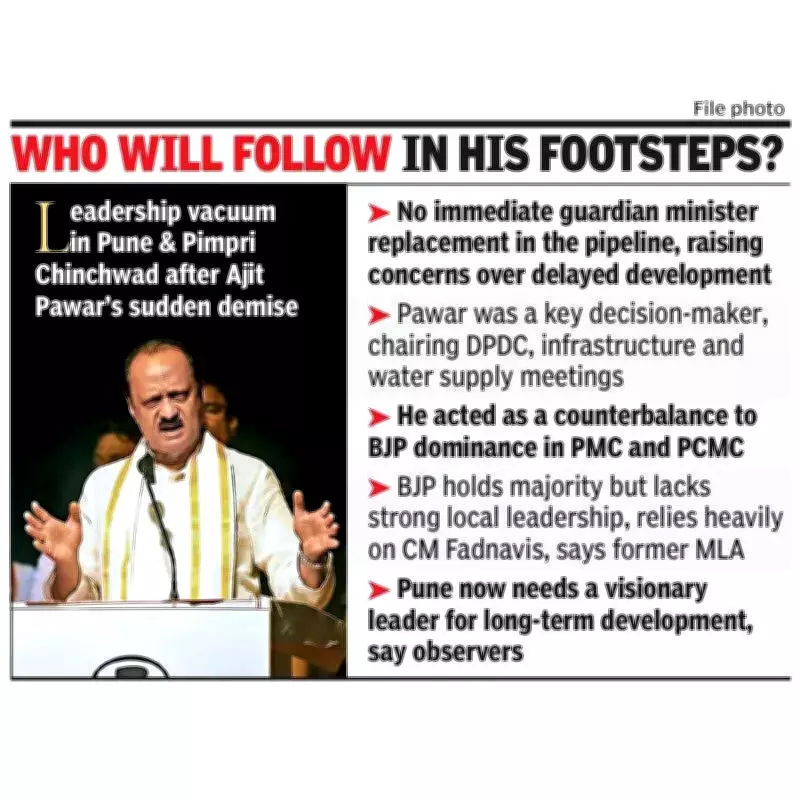
The sudden and unexpected demise of Nationalist Congress Party (NCP) chief Ajit Pawar on Wednesday has plunged Pune and Pimpri Chinchwad into a state of political uncertainty, creating a significant leadership vacuum that threatens to disrupt the region's development trajectory. With no immediate replacement visible for the crucial position of guardian minister, both the administration and political parties face the daunting challenge of maintaining momentum on numerous infrastructure and civic projects that were closely monitored by the veteran leader.
A Political Powerhouse's Legacy
Ajit Pawar executed and oversaw countless development initiatives during his extensive tenure as Pune district guardian minister. His first stint spanned nearly a decade from 2004 to 2014, followed by subsequent terms from 2019 to 2022 and again from 2023 until his passing. Throughout these periods, he emerged as the primary counterbalance to the Bharatiya Janata Party's (BJP) growing dominance within the Pune Municipal Corporation (PMC) and Pimpri Chinchwad Municipal Corporation (PCMC).
Even when the BJP commanded complete majorities in both municipal corporations from 2019 to 2022, Pawar maintained his influential position, standing as a formidable check on decision-making processes. Political sources indicate that his presence in the guardian minister role was widely viewed as an essential mechanism for ensuring accountability and preventing unilateral actions by the ruling party.

Hands-On Governance Style
Pawar was renowned for his hands-on approach to governance, regularly conducting follow-up meetings with civic officials and district authorities. He personally chaired all critical gatherings, including District Planning and Development Committee (DPDC) sessions, infrastructure development reviews, and water supply discussions. It was only under his direct supervision that significant decisions concerning the city's future were finalized, despite the BJP fielding more elected representatives and cabinet ministers than the NCP or any other political entity.
This dynamic persisted even after the BJP retained clear majorities in both PMC and PCMC during recent civic body elections, with Pawar continuing to supervise the functioning of these municipal bodies as guardian minister. His unique ability to navigate political complexities while driving development made him an irreplaceable figure in Pune's administrative landscape.
The Current Political Landscape
While the BJP may now hold a slight advantage in the absence of its most prominent challenger, sources reveal that the party lacks visionary guidance at the local level capable of matching Ajit Pawar's political acumen and implementation power. A former city MLA articulated this concern clearly, stating, "There is no leader in Pune who can work as effectively as Ajit Dada. The BJP remains heavily dependent on Chief Minister Devendra Fadnavis for crucial decisions."
The recent civic election campaign underscored this dependency, with Fadnavis leading BJP's efforts through multiple rallies across the city and concluding the public campaign with his own gathering in Gokhalenagar. This pattern served as a clear indication that the BJP lacks strong, autonomous leadership at the city level, relying instead on state-level figures to drive local political momentum.
Historical Context and Future Challenges
A political observer from Pune noted that over the past three decades, two leaders have predominantly shaped the city's development narrative: Congress leader Suresh Kalmadi and NCP's Ajit Pawar. With both figures now absent from the political scene, Pune and Pimpri Chinchwad urgently require a competent guide with a clear, long-term vision for development spanning the next thirty years.
The void left by Pawar's passing extends beyond mere political positioning; it represents a crisis of leadership that could potentially slow down critical infrastructure projects, delay administrative decisions, and create uncertainty in governance structures. The coming months will test whether existing political frameworks can adapt to this new reality or whether Pune will experience a period of developmental stagnation until new leadership emerges.