

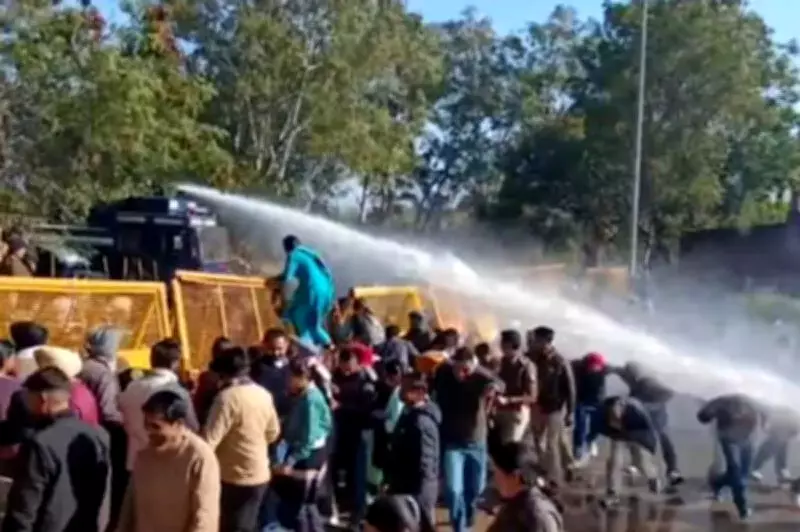
Police Use Water Cannons and Lathi-Charge on Punjab Teachers' Protest March
A protest march organized by special cadre teachers in Mohali demanding resolution of long-pending issues turned violent on Sunday when police resorted to using water cannons and conducting a lathi-charge at the Chandigarh-Mohali border. The confrontation resulted in injuries to at least five teachers, including three women, with union president Davinder Singh Sandhu sustaining a significant knee injury during the police action.
Peaceful March Escalates into Violent Confrontation
The protest was organized under the banner of the Special Cadre Teachers Front (Punjab), with approximately 500 educators gathering in the morning at Gurdwara Sri Amb Sahib in Mohali. The teachers began what they described as a peaceful march toward Chandigarh, seeking a direct meeting with Chief Minister Bhagwant Mann to address their unresolved demands regarding pay scales and service benefits.
Police attempted to halt the march at multiple points within Mohali, but the teachers insisted on proceeding toward the state capital. When protesters reached the Chandigarh border, authorities had erected heavy barricades to block their path. As teachers attempted to move forward, police first deployed water cannons, creating chaos at the site and allegedly dislodging turbans from several protesters due to the force of the water jets.

When the teachers refused to disperse despite the water cannon deployment, the situation escalated further as police carried out a lathi-charge. In the ensuing action, five teachers sustained injuries, including three women and union President Davinder Singh Sandhu. All injured protesters were subsequently transported to the civil hospital for first aid and medical treatment.
Longstanding Grievances Behind the Agitation
Speaking to media representatives, Sandhu explained that the teachers felt compelled to organize the protest because the government had been ignoring their demands for an extended period. He revealed that on July 28, 2023, approximately 12,710 temporary teachers had received regular appointment letters, but nearly two years later, they still had not been granted proper pay scales and essential service benefits.
The teachers' key demands include:
- Implementation of appropriate pay scales for all 12,710 special cadre teachers
- Implementation of service rules and facilities including travel allowance, medical reimbursement, and group insurance
- Implementation of the Old Pension Scheme, gratuity, promotion channels, mobile allowance, and child care leave
- Enhancement of retirement age from 58 to 65 years as mandated by high court orders
- Issuance of permanent appointment letters to remaining contractual teachers at the earliest opportunity
Temporary Resolution and Future Threats
The protest began around 1 PM and continued for several hours amid escalating tensions. Following the violent confrontation, the Chandigarh administration provided assurances that a meeting with Chief Minister Bhagwant Mann would be arranged on Monday at approximately 4:30 PM. Additionally, Mohali DSP Harsimran Singh Bal promised the teachers that a meeting with the education minister would be scheduled for February 11.
After receiving these assurances, the teachers temporarily called off their protest. However, the union issued a stern warning that if concrete decisions addressing their demands were not made promptly, they would intensify their agitation across the entire state of Punjab, potentially organizing larger and more widespread protests.
The incident highlights the ongoing tensions between government employees and administration regarding implementation of promised benefits and proper compensation structures, with educators increasingly resorting to public demonstrations to draw attention to their unresolved grievances.






