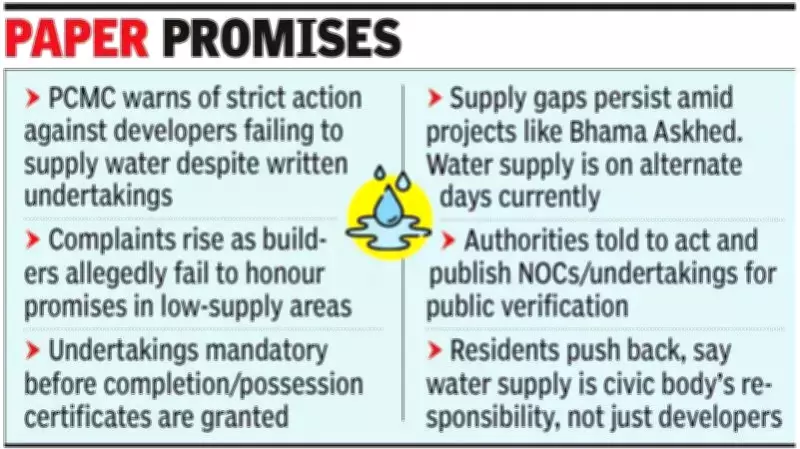
PCMC Issues Stern Warning to Developers Over Water Supply Failures
The Pimpri Chinchwad Municipal Corporation (PCMC) has issued a strong warning to real estate developers, threatening strict legal action against those who fail to provide adequate water supply to housing societies despite submitting written undertakings promising the same. This move comes in response to numerous complaints from residents who have been left without reliable water access.
Growing Crisis in Water-Deficient Areas
Officials have revealed that in several areas experiencing inadequate municipal water supply, builders had formally assured residents that they would arrange alternative water sources until civic infrastructure became fully operational. However, numerous developers have reportedly failed to honor these commitments, leaving residents struggling with water shortages.
The issue was discussed extensively during a high-level meeting held at the divisional commissioner's office on Friday. This meeting was convened in connection with an ongoing public interest litigation before the Bombay High Court. Representatives from PCMC, Pune Municipal Corporation (PMC), and PMRDA were all present for these crucial discussions.

Infrastructure Challenges and Developer Responsibilities
PCMC officials explained during the meeting that they are currently unable to provide 100% of the promised water supply in certain areas due to ongoing infrastructure projects. The most significant of these is the Bhama Askhed scheme, which is expected to add 167 million liters per day (MLD) to the current water supply once completed.
At present, the civic body supplies water on alternate days from two primary sources: Pavana dam (530 MLD) and Andra dam (100 MLD), with MIDC providing an additional 30 MLD. Officials emphasized that it is mandatory for developers to provide written undertakings assuring water supply at their own cost until municipal systems become fully functional. These undertakings must be submitted before civic bodies grant completion or possession certificates for new developments.
Strict Action Ordered Against Non-Compliant Developers
A senior PCMC official confirmed that the divisional commissioner has directed authorities to take strict action against developers who fail to comply with their written undertakings. This includes those who attempt to pass the financial burden of water supply to residents, forcing them to rely on expensive private water tankers.
Additionally, the civic body has been instructed to publish all relevant no-objection certificates and water supply undertakings on its official websites. This transparency measure will enable residents to verify developers' commitments and hold them accountable for any failures.
PCMC commissioner Vijay Suryawanshi stated unequivocally, "Such developers are legally bound to fulfill their commitments. Any failure or denial in this regard will be treated as a violation and we will initiate strict legal action on complaints by residents. The developers' responsibility shall continue till the Bhama Askhed scheme is fully commissioned and operational."
Residents Question Municipal Responsibility
While many residents have welcomed the civic body's intervention against negligent developers, several have criticized what they see as an attempt to shift responsibility away from the municipal corporation itself.
Dattatray Deshmukh, President of the Pimpri Chinchwad Housing Societies Federation, argued strongly that supplying water is fundamentally the municipal corporation's responsibility. "The civic body collects water tax, so it must ensure the supply. It is unfair to make residents depend on private entities for such a basic necessity," he stated.
Deshmukh further questioned the logic of granting permissions to new residential projects without adequate water arrangements already in place. "If the civic body itself admits they do not have sufficient water, they should clarify how the developers will arrange it," he said, noting that several older housing societies continue to face severe water shortages. He asked pointedly who residents should approach for relief when both developers and the municipal corporation fail to provide this essential service.

Resident Experiences Highlight Systemic Issues
Ravet resident Rahul Shinde shared his community's experience, stating, "It looks like PCMC's attempt to clear more residential projects despite inadequate water supply. If this continues, more residents will suffer. The civic body will have to take responsibility. The housing society I stay in depends on water tankers every summer and spends lakhs of rupees on it. Neither the builder nor the municipal corporation bears the cost."
This situation highlights the broader challenges facing rapidly developing urban areas where infrastructure struggles to keep pace with residential expansion. The conflict between developer promises, municipal responsibilities, and resident needs creates complex governance challenges that require coordinated solutions.
The PCMC's warning to developers represents an important step toward accountability, but the ongoing criticism from residents suggests that more comprehensive solutions may be needed to address the fundamental water supply issues affecting housing societies across the region.