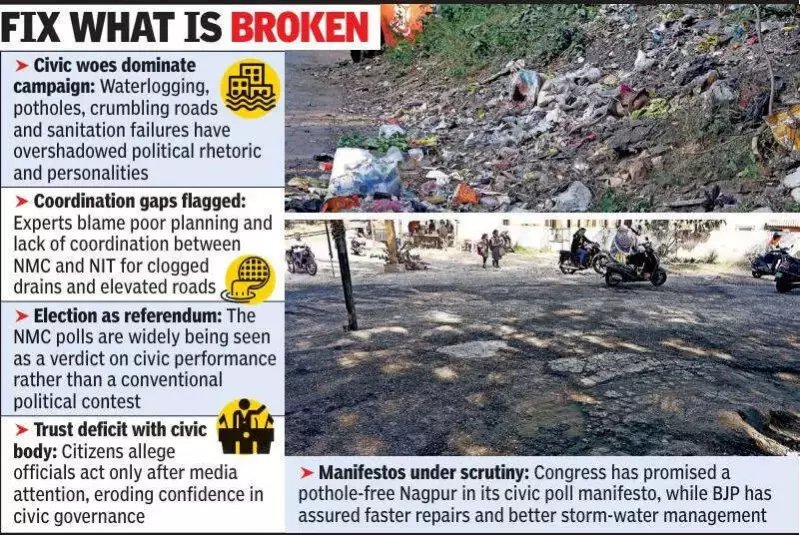
With the Nagpur Municipal Corporation (NMC) elections scheduled for January 15, the political discourse in the city has undergone a significant shift. The focus has moved decisively away from personalities and political rhetoric, centering squarely on the crumbling state of civic infrastructure. For Nagpur's residents, the ballot is becoming a direct referendum on basic governance, with waterlogging, dangerous potholes, and sanitation failures dominating their concerns.
Parties Rework Pitch as Public Anger Boils Over
Sensing the palpable frustration on the ground, political parties have been forced to tailor their campaigns around civic woes. The Congress party has made a prominent pledge in its manifesto, promising to transform Nagpur into a "pothole-free city". They argue that the deteriorating road network is a glaring symbol of years of administrative neglect.
The Bharatiya Janata Party (BJP), which has held power in the civic body for the last three consecutive terms, is countering with assurances of accelerated road repairs, improved storm-water management systems, and major upgrades to civic amenities. The incumbent party insists that several ongoing projects are on the verge of showing results and requests another mandate to see them through.

On Ground, Day-to-Day Hardships Trump Manifestos
However, for the average citizen, manifestos often feel distant compared to immediate daily struggles. The situation has notably worsened since the 2023 monsoon, which exposed severe inefficiencies in the city's drainage. Areas along the Ambazari downstream and the Nag River bore the brunt, with flash floods entering homes and bringing normal life to a standstill.
Many citizens point a finger at the construction of elevated cement-concrete roads, which they believe trap rainwater instead of allowing it to drain away. In West Nagpur, localities like Dharampeth and Dhantoli are grappling with tar roads that are disintegrating rapidly.
"Every rainfall turns our street into a small lake. Children cannot play, and vehicles get stuck. We are fed up with promises but see no action," said Anjali Patil, a resident of Dhantoli. The sentiment echoes across the city.
From East to North Nagpur, complaints are similar. Shopkeeper Ramesh Chand from Jaripatka colony highlighted the reactive nature of the administration: "The roads outside our colony have deep, risky potholes. NMC officials only visit after media attention." In Pardi, the fear of disease looms large due to stagnant water near drainage outlets. "Our children fall sick repeatedly," shared homemaker Meera Singh.
Systemic Failures and Superficial Repairs
Urban development experts identify a core structural problem: poor coordination between the NMC and the Nagpur Improvement Trust (NIT). An urban development consultant explained that overlapping projects executed without integrated planning lead to clogged drains, ill-conceived road elevations, and a landscape littered with half-finished work.
Beyond planning, the quality of maintenance itself is under severe scrutiny. Residents allege that repairs are cosmetic and short-lived. "Repairs are done superficially and then crumble again. It has become a yearly ritual," noted Harish Kale from Mankapur, voicing a common grievance about a cycle of temporary fixes.
Performance, Not Slogans, Will Decide Votes
As polling day approaches, the electorate's message is blunt and performance-oriented. For voters like Shweta Jadhav from Ambazari, ideology is secondary to delivery. "We are voting for whoever fixes roads, clears drains, and manages water properly," she stated, summarizing the prevailing mood.
The campaign noise may be growing louder, but the core demand from Nagpur's citizens remains simple and direct: fix what is broken. This election is less about political allegiance and more a practical test. The fundamental question for Nagpur is whether the next civic board can finally provide safe roads, functional drains, and reliable services, moving beyond the endless cycle of paper promises to tangible action on the ground.