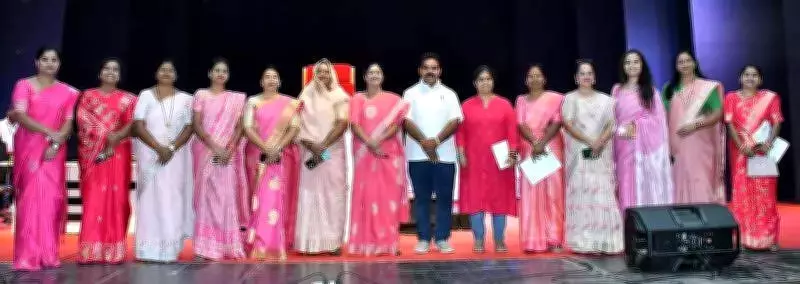
Nagpur Civic Body Embraces 'Mahila Raj' as BJP Installs All-Women Leadership
In a groundbreaking political development with significant national implications, Nagpur's municipal governance structure has undergone a dramatic transformation, turning decisively pink. Leveraging its commanding majority in the 151-member Nagpur Municipal Corporation (NMC), the Bharatiya Janata Party (BJP) has engineered an unprecedented scenario where women will now lead every major committee, including the influential 16-member standing committee that controls the civic body's financial operations.
Unprecedented Gender Shift in Civic Representation
The structural gender shift became evident when 78 women corporators were elected across various political parties in the recent municipal elections. This remarkable number represents a watershed moment in Nagpur's civic history, with women securing representation from diverse political affiliations including BJP, Congress, AIMIM, IUML, Shiv Sena (UBT), Shiv Sena (Shinde), BSP, and the NCP (Ajit).
What makes this development particularly noteworthy is that two of these women triumphed in general (unreserved) seats, defeating male contenders—an exceptional achievement in the city's municipal political landscape that traditionally saw limited female representation in non-reserved constituencies.
Formalizing the All-Women Leadership Structure
During a specially convened general body meeting on Tuesday, the ruling BJP solidified its vision by securing 11 of the 16 seats on the crucial standing committee while formalizing an entirely female leadership lineup for key municipal panels. With both the mayor and deputy mayor positions already occupied by women, the BJP is strategically positioning this development as the advent of "Mahila Raj" in Nagpur—a governance model the party may potentially amplify in its broader political messaging across India.
Shivani Dani was appointed as the chairperson of the standing committee, widely recognized as the financial nerve center of the municipal corporation. Meanwhile, Mangala Khekre was elected to lead the transport committee, which oversees critical city bus operations and related infrastructure development.
All 11 BJP members nominated to the standing committee are women corporators—a move that party leaders assert is unprecedented in the civic body's history. This strategic decision grants women direct control over essential municipal functions including budget approvals, tender processes, and major expenditure proposals.
Committee Composition Reflects Political Dynamics
The composition of the standing committee clearly demonstrated the BJP's numerical dominance within the municipal corporation. Based on established weightage points, the BJP secured 11 seats (10.81 points), while the Congress–Uddhav Thackeray faction, operating under the Nagpur Vikas Aghadi banner, obtained four seats (3.81 points).
The AIMIM and Indian Union Muslim League (IUML) formed an alliance called the Muslim Bahujan Vikas Aghadi and secured one seat (1.06 points), represented by Aslam Khan. In the transport committee, the BJP obtained eight seats, Nagpur Vikas Aghadi three, and Muslim Bahujan Vikas Aghadi one, with Khekre assuming leadership of this important panel.
Comprehensive Governance Transformation
The gender shift extends far beyond these two prominent committees. All 10 special committees of the municipal corporation will now be chaired by BJP women corporators, effectively consolidating the party's control over both financial and policy decision-making arms of the civic administration.
Politically, this strategic move allows the BJP to reinforce its majority while simultaneously crafting a powerful women-centric governance narrative. By placing women at the helm of finance, transport, and special committees, the party has skillfully blended symbolic representation with substantive structural authority.
Opposition Dynamics and Strategic Alliances
While the BJP dominated the committee formations, interesting developments emerged within the opposition ranks. AIMIM, which made its civic debut with six first-time corporators, faced challenges due to limited experience in navigating the corporation's complex procedures. In contrast, IUML's three-term corporator Aslam Khan brought valuable institutional familiarity and committee-level exposure to the table.
Although IUML was not independently eligible for representation under the initial formula, Khan strategically aligned with AIMIM to alter the mathematical calculations. This alliance enabled him to secure a berth in the Standing Committee, with AIMIM supporting its experienced ally over a first-time entrant from its own ranks.
This political experiment in Nagpur represents more than just symbolic representation—it establishes women in positions of genuine financial and administrative power within municipal governance. The development signals a potential shift in how political parties might approach gender representation in urban governance structures across India, with the BJP positioning Nagpur as a model for women-led civic administration.