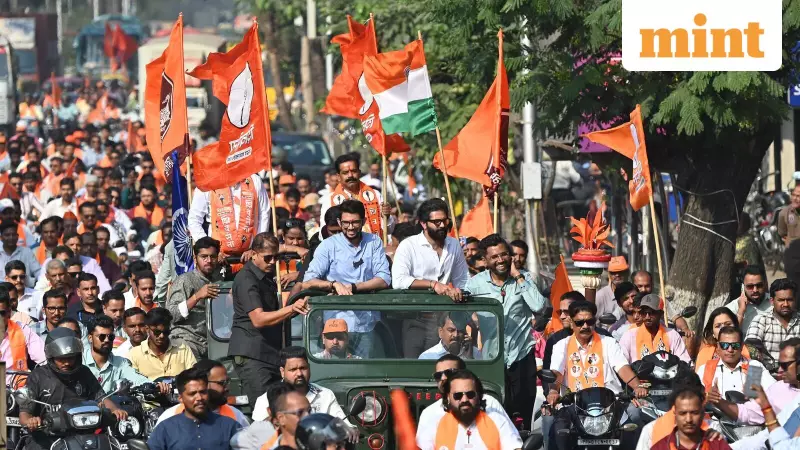
Mumbai Prepares for Crucial BMC Elections on January 15
The long-awaited Brihanmumbai Municipal Corporation elections will finally happen on Thursday, January 15. Voters across Mumbai's 227 civic wards will cast their ballots from 7:30 AM to 5:30 PM. Election officials will count all votes the very next day on Friday, January 16.
Voters and candidates are ready for this important democratic exercise. A total of 1,700 candidates have entered the electoral fray. This group includes 878 women candidates and 822 men. Mumbai's electorate stands at 1,03,44,315 registered voters. The voter breakdown shows 55,15,707 men, 48,26,509 women, and 1,099 voters in other categories.
Why Did the BMC Polls Face Repeated Delays?
The last BMC elections occurred back in 2017. Corporators completed their five-year terms on March 7, 2022. Subsequent elections could not happen on schedule, forcing the civic body to operate under an appointed administrator.

Multiple factors contributed to the prolonged delay. Maharashtra initially postponed civic body elections scheduled for 2020 due to the COVID-19 pandemic. Later, planned March 2022 elections faced another deferral. The Supreme Court required a rigorous empirical inquiry before allowing Other Backward Class quota implementation in local body elections.
On July 21, 2022, the Supreme Court accepted the State commission's report and permitted up to 27 percent OBC reservation in nagar panchayat, nagar parishad, and BMC elections. However, the court specifically instructed the State Election Commission not to re-notify election programs for 367 local bodies, including the BMC, to implement this reservation.
The very next day, July 22, 2022, the SEC reclassified BMC wards anyway. They announced that out of 236 total seats, 156 would remain general category, 15 would reserve for Scheduled Castes, two for Scheduled Tribes, and 63 for OBC category. The Supreme Court responded by warning the SEC against renotifying election programs and ordered status quo on OBC reservations.
Ward Delimitation Created Additional Complications
Mumbai faced another hurdle with municipal ward delimitation. The Maha Vikas Aghadi government led by Chief Minister Uddhav Thackeray decided to increase BMC seats from 227 to 236. This decision triggered ward redrawing by the SEC in February 2022.
Following the Shiv Sena split, the subsequent Eknath Shinde government withdrew this order in August 2022. The Bombay High Court upheld this withdrawal order in April 2023.
Finally, on August 4, 2025, the Supreme Court directed the SEC to conduct all Maharashtra local body polls by January 2026. The court mandated elections with new ward reservations and 27 percent OBC reservation. Supreme Court justices also criticized the SEC for unnecessary election delays.
Looking Back at the 2017 BMC Election Results
The 2017 BMC elections produced dramatic political theater. Shiv Sena, which had controlled Mumbai's civic body since 1985, nearly lost its dominance to the BJP. The undivided Shiv Sena won 84 seats while BJP secured 82 seats.
Neither party achieved an outright majority in the 227-seat corporation. This forced an uneasy bargain where BJP allowed Shiv Sena to retain the mayor's post. Following the disintegration of their original coalition and the Shiv Sena split, BJP now aims to finally break Sena's power center. They hope to install Mumbai's first BJP mayor.
Constitutional Framework for Local Body Elections
The Constitution's 73rd and 74th amendments, passed by Parliament in 1992, established rural and urban local self-government bodies. Citizens directly elect representatives to these bodies. State election commissions hold elections for these local governments.
Every Panchayat or urban civic body operates with a five-year term. The Constitution mandates that one-third of seats reserve for women. Seats proportional to the SC/ST population in each State reserve for these communities. States may provide OBC reservation if they find it necessary.
State election commissions function as autonomous bodies. Their commissioners serve as independent officers who do not fall under the control of the Election Commission of India.

With elections now scheduled for January 15, Mumbai's long electoral hiatus will finally end. Voters will return representatives to manage India's richest municipal corporation. This body oversees one of the largest civic budgets in the entire country.