Madhya Pradesh to Present First Paperless Budget with Agriculture Focus
In a significant move toward digital governance, the Madhya Pradesh government will present its first completely paperless budget in the state assembly on February 18. This marks a departure from traditional practices where heavy bundles of budget booklets were distributed. Instead, only the finance minister's budget speech and a limited number of budget handouts will be printed, reflecting the state's commitment to environmental sustainability and efficiency.
Digital Transformation and Sectoral Priorities
This paperless initiative follows the successful implementation of the e-office system and e-cabinet in Madhya Pradesh, showcasing the state's progressive approach to administrative processes. The budget is expected to place a strong emphasis on the agriculture sector, aligning with the government's declaration of 2026 as the agriculture year. A substantial allocation is anticipated for Simhastha 2028, highlighting the state's focus on cultural and religious events alongside economic development.
Additionally, the government plans to expand the scope of existing welfare schemes across various departments, aiming to enhance social security and public welfare. These measures are designed to address the needs of rural and agricultural communities, which form a critical part of Madhya Pradesh's economy.

Innovative Budgeting Techniques and Financial Strategies
In a groundbreaking move, the Madhya Pradesh government is introducing a rolling budget system for the first time. This innovative approach involves preparing budgets for 2026-27, 2027-28, and 2028-29, with annual reviews and adjustments to ensure policies remain forward-looking and resilient to short-term pressures. This builds on last year's introduction of zero-based budgeting, where all expenses must be justified from scratch each period.
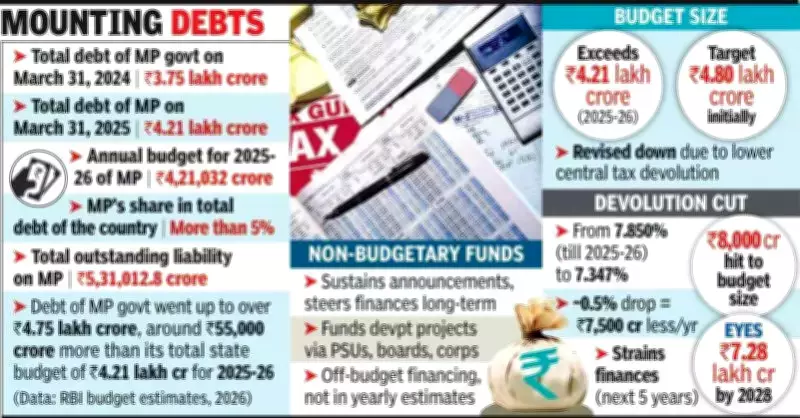
Furthermore, the government will adopt non-budgetary provisions starting next year to manage funds for ongoing development projects and announcements made on various occasions. These provisions involve financing government projects through state-owned enterprises, boards, and corporations, without routing them through the annual state budget. This strategy aims to provide greater flexibility in steering the state's financial activities over the coming years.
Budget Size and Central Tax Devolution Impact
The size of the Madhya Pradesh budget for 2026-27 is projected to be higher than the previous year's budget of Rs 4.21 lakh crore, with expectations of reaching around Rs 4.80 lakh crore. However, this increase will fall short of initial government plans due to a reduction in the state's share of central taxes. Officials have noted that Madhya Pradesh's share has decreased from 7.850% to 7.347%, resulting in a budget shrinkage of at least Rs 8,000 crore.
This approximate 0.5% cut in yearly devolution means the state will receive around Rs 7,500 crore less annually from the Centre over the next five-year period, putting additional strain on Madhya Pradesh's financial condition. Despite this challenge, the government remains committed to its long-term goal of exceeding Rs 7.28 lakh crore by 2028, with steady increases planned between 2024 and 2028.
Final Approval and Forward-Looking Policies
The state budget has been finalized, with Chief Minister Mohan Yadav approving the proposals for 2026-27 on February 10. He described them as better suited to the present context, emphasizing the government's focus on sustainable and innovative financial management. The introduction of paperless processes, rolling budgets, and non-budgetary provisions underscores Madhya Pradesh's efforts to modernize its fiscal policies while addressing key sectoral needs like agriculture.