

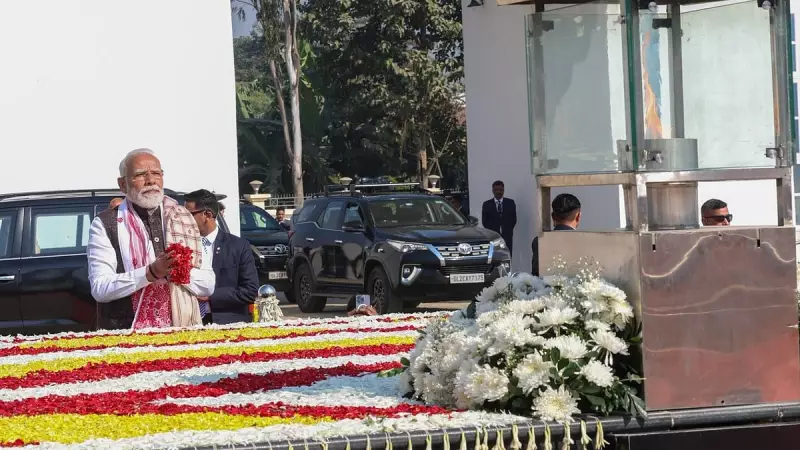
Prime Minister Narendra Modi engaged in a significant political act in Assam on Sunday, paying solemn tributes to the martyrs of the historic Assam Agitation. This gesture came immediately after he launched a sharp critique against the Congress party, accusing it of compromising on the critical issue of infiltration for the sake of vote bank politics.
A Day of Contrasts: Critique and Homage
During a large public rally in Guwahati, Prime Minister Modi did not mince words while targeting the principal opposition party. He asserted that the Congress had historically treated the serious matter of infiltration into Assam lightly, prioritizing electoral gains over national security and the cultural identity of the state. He specifically referenced the party's approach during the Assam Movement, a six-year-long protest from 1979 to 1985.
Following this political offensive, the Prime Minister's schedule took a reverent turn. He visited the memorial of the Assam Agitation martyrs located at the Assam Accord memorial site in Guwahati's Srimanta Sankardev Kalakshetra. There, he paid floral tributes, honoring the memory of those who lost their lives during the mass movement.

The Legacy of the Assam Movement
The Assam Agitation, also widely known as the Assam Movement, remains a pivotal chapter in the state's history. It was a sustained, peaceful protest led by the All Assam Students' Union (AASU) and the All Assam Gana Sangram Parishad (AAGSP). The core demand of the agitation was the identification and deportation of illegal immigrants, primarily from Bangladesh, whose presence, the protesters argued, was altering the demographic and cultural fabric of Assam.
The movement culminated in the signing of the Assam Accord on August 15, 1985, a memorandum of settlement between the central government, led by then-Prime Minister Rajiv Gandhi, and the leaders of the agitation. The accord set a cut-off date for the detection and deportation of foreigners, a complex issue that continues to resonate in the state's politics and society.
Political Significance of the Tribute
Prime Minister Modi's visit to the martyr's memorial is laden with deep political symbolism. By honoring the martyrs right after criticizing the Congress, he sought to position himself and his party, the Bharatiya Janata Party (BJP), as the true inheritors and protectors of the Assam Agitation's core cause—protecting Assam from illegal infiltration.
This move is seen as a strategic effort to consolidate the BJP's support base in the Northeast, particularly in Assam, where issues of identity and migration are highly sensitive. It reinforces the party's narrative of being a steadfast guardian of national security and regional interests, in contrast to its portrayal of the Congress as opportunistic.
The tribute also serves to acknowledge the deep emotional connection the people of Assam have with the movement and its sacrifices. For many families, the martyrs are local heroes, and a Prime Ministerial homage validates their struggle on a national platform.
Broader Implications and Reactions
This two-pronged approach—a direct political attack followed by a solemn state gesture—highlights the blend of strategy and symbolism that characterizes modern Indian politics. The event in Guwahati is expected to feature prominently in the BJP's campaign rhetoric in the region, especially with an eye on future electoral battles.
While the BJP and its allies have hailed the Prime Minister's visit as a respectful acknowledgment of Assam's history, opposition parties are likely to view it through a lens of political expediency. They may argue that the tribute is an attempt to appropriate a legacy for contemporary political gain.
Nevertheless, the day's events underscore the enduring relevance of the Assam Agitation's core issues in the state's political discourse. The questions of citizenship, cultural preservation, and national security that fueled the movement decades ago continue to shape policy debates and political alignments in Assam today.
Prime Minister Narendra Modi's actions in Guwahati—his strong words against the Congress and his respectful homage at the memorial—have firmly placed these historical and contemporary themes back at the center of public conversation in Northeast India.






