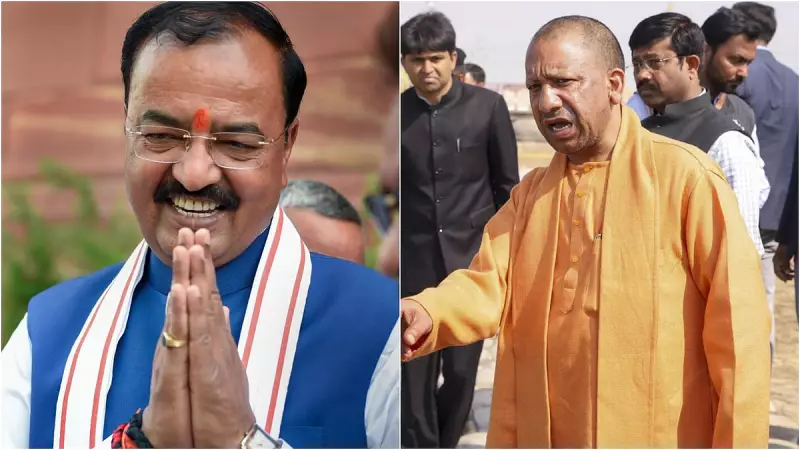
A recent public comment by Uttar Pradesh Deputy Chief Minister Keshav Prasad Maurya has ignited a fresh wave of speculation about a growing rift within the state's top leadership. Maurya's remark, interpreted by many as a veiled critique of Chief Minister Yogi Adityanath, has brought the long-simmering tensions between the two BJP leaders into sharp public focus.
The Remark That Started It All
While addressing a public gathering, Keshav Prasad Maurya made a statement about ensuring that "roti" (bread) reaches every "Baba." This seemingly innocuous comment was quickly decoded by political observers as a pointed reference. In the context of Uttar Pradesh politics, "Baba" is often used to refer to Yogi Adityanath, who is a Hindu monk. The implication, analysts suggest, is that the Deputy CM was highlighting his own role in the administration's welfare schemes, subtly positioning himself as a key provider.
The comment, made on 01 January 2026, was reported by journalist Sanjay Pandey and has since become a major talking point. It underscores the reported cold war between the Chief Minister and his deputy, a dynamic that has been noted by party insiders and political commentators for some time.
A History of Underlying Tensions
This is not the first instance hinting at discord between Yogi Adityanath and Keshav Prasad Maurya. The two leaders, despite belonging to the same party, have reportedly been at loggerheads for a considerable period. Their differing political styles and backgrounds are often cited as reasons for the friction.
Observers point to several factors fueling this rivalry:
- Political Base: Both leaders command significant but distinct support groups within the state's complex caste and social matrix.
- Administrative Control: Questions often arise about the distribution of power and influence within the state cabinet.
- Future Ambitions: The political trajectory of both leaders within the BJP's hierarchy is a constant subject of speculation.
Maurya's latest remark is seen as a continuation of this passive-aggressive communication, using symbolic language to convey a political message without making a direct accusation.
Implications for BJP and Uttar Pradesh Politics
The public airing of this internal tension poses a challenge for the Bharatiya Janata Party (BJP). Uttar Pradesh is India's most politically crucial state, and a united front is considered essential for the party's electoral fortunes. Open discord between its two most prominent faces in the state could send wrong signals to the cadre and the electorate.
The party's central leadership often prefers to manage such internal dynamics behind closed doors. However, when remarks like Maurya's make headlines, it forces the issue into the public domain. The BJP will likely need to engage in damage control to present a picture of cohesion, especially with an eye on future electoral battles.
For the state's governance, a strained relationship at the top can potentially lead to delays in decision-making and create factions within the bureaucracy. The focus may shift from administrative efficiency to political one-upmanship, which could impact policy implementation.
In conclusion, Keshav Prasad Maurya's "roti for Baba" comment is more than a fleeting political soundbite. It is a significant indicator of the ongoing and delicate power balance within the Uttar Pradesh BJP. How the party manages this episode will be closely watched, as it reflects on both the stability of the state government and the BJP's internal discipline ahead of key political milestones.