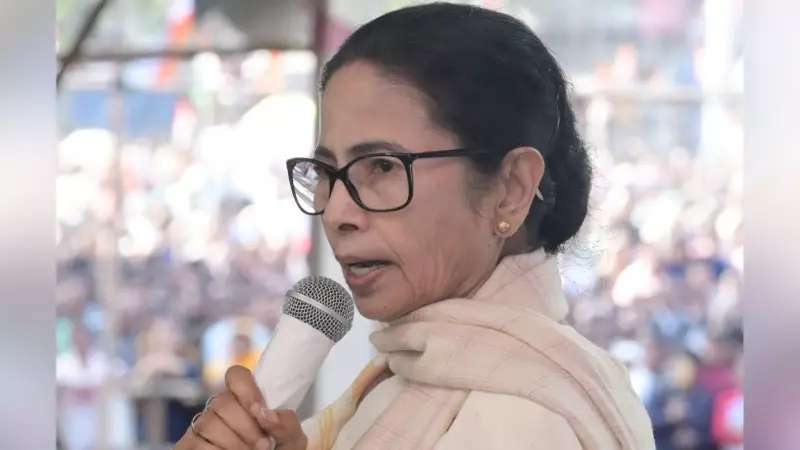
In a strongly worded communication, West Bengal Chief Minister Mamata Banerjee has escalated her confrontation with the Election Commission of India (ECI), urging the poll body to either correct significant irregularities in an ongoing electoral roll revision or suspend the process entirely. This marks her third letter to the Chief Election Commissioner in less than two months.
Escalating Concerns Over Democratic Process
Addressing Chief Election Commissioner Gyanesh Kumar, Banerjee expressed "grave concerns" regarding the Special Intensive Revision (SIR) of the electoral rolls. She characterized the exercise as "fundamentally flawed" and warned that it risks reducing India's democratic process to a "farce." The Chief Minister stated that the current "unplanned, arbitrary, and ad hoc" revision strikes at the core framework of democracy.
Banerjee had previously written to the CEC on November 20 and December 2. In her latest letter, she contended that the ground situation has "deteriorated further" despite her earlier alerts about serious procedural lapses.

Allegations of Technical Misuse and Administrative Lapses
The Trinamool Congress supremo detailed a series of alleged failures in the revision process. She pointed to "defective and unstable" IT systems and a lack of uniform training for the officials involved. A major accusation involved the "backend deletion" of voters, where she claimed IT systems are being manipulated to remove electors without the knowledge or consent of the legally authorized Electoral Registration Officers (EROs).
Banerjee also highlighted issues of inconsistency and informality. She alleged that critical instructions are being circulated through unofficial channels like WhatsApp instead of statutory orders, which she said erodes "accuracy, transparency, or accountability." Any error in this process, she warned, could lead to the "potential disenfranchisement of genuine electors."
Further, she cited discrimination in document acceptance, noting that while the 'Family Register' was accepted as identity proof in Bihar, it is being rejected in West Bengal via informal messages. "Such selective and unexplained exclusion... raises serious concerns of discrimination and arbitrariness," she wrote.
Impact on Migrants, Elderly, and Questions on Neutrality
The Chief Minister turned the focus on the hardship faced by ordinary citizens, particularly migrant workers and the elderly. She accused the EC of "insensitivity" for summoning citizens, including the infirm, to travel 20–25 kilometers for centralized hearings. Migrant workers, she claimed, are being forced to appear for physical verification despite being eligible, a procedure she says is not followed in other states.
"Electors are being summoned for hearings without being informed of the specific reasons… thereby subjecting them to needless anxiety and harassment," the letter stated.
Banerjee also questioned the neutrality of the entire exercise. She criticized the appointment of observers and micro-observers without consultation with the state government. The engagement of Group B central government employees, who she claims lack specialized training, was described as a move that "adversely affects the fairness, neutrality, and credibility of the entire process."
Urgent Call for Intervention
In her concluding remarks, the West Bengal CM made a direct appeal for the CEC's intervention. "I strongly urge you to immediately address and rectify the glitches, address the flaws, and make the necessary corrections, failing which this unplanned, arbitrary, and ad hoc exercise must be halted," she wrote.

She ended with a stark warning: "If allowed to continue in its present form, it will result in irreparable damage, large-scale disenfranchisement of eligible voters, and a direct assault on the foundational principles of democratic governance." The letter underscores the growing tension between the state government and the Election Commission over the crucial pre-poll exercise.