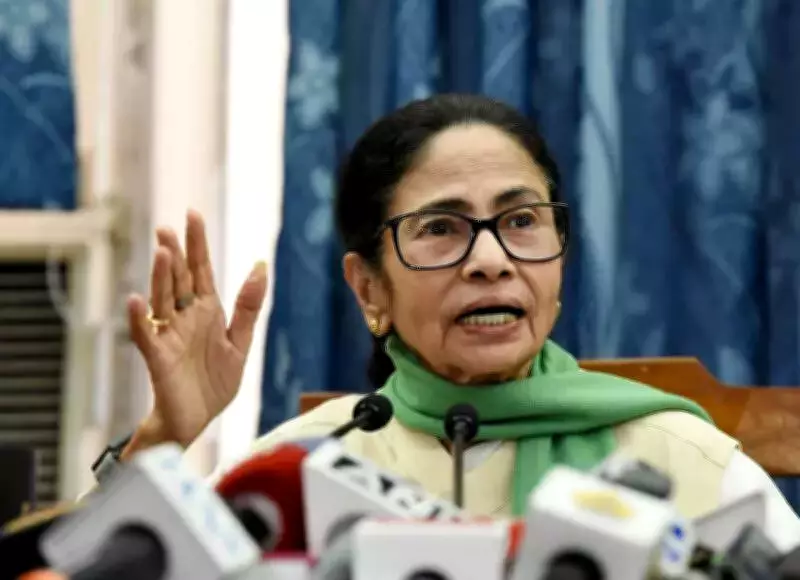
Mamata Banerjee Criticizes Union Budget, Lauds Bengal's Development-Oriented Budget
West Bengal Chief Minister Mamata Banerjee on Thursday launched a scathing attack on the Union budget, labeling it as "visionless, missionless and actionless" and accusing it of derailing the economy. In contrast, she presented Bengal's vote-on-account budget as a model focused squarely on the development of the people.
Bengal's People-Friendly Budget Amid Central Deprivation
Speaking to reporters after the budget presentation, Banerjee emphasized that Bengal has delivered a people-friendly budget "despite the deprivation from the central government." She asserted, "We are fighting because people have faith in us." The Chief Minister highlighted her government's commitment to fulfilling promises, stating, "We say what we can do. We don't make fake promises when elections are impending. Whatever we said before polls, we implemented and executed to the best of our capacity."
As a tangible example, she announced that beneficiaries of the Lakshmir Bhandar scheme will receive an additional amount of Rs 500 starting from February itself.

Economic Achievements and New Social Schemes
Banerjee strongly rebutted BJP's claims regarding unemployment in Bengal, citing a Government of India report that indicates a 45.6% reduction in unemployment. She proudly noted, "We pulled 1 crore 72 lakh people out of poverty. It's a big part of development."
The budget introduced several new initiatives, bringing the total number of social schemes in the state to over 100. Banerjee explained, "We had 94 schemes before today. Today, 5-6 new schemes were added. I think we crossed 100 in terms of social schemes." One significant change is the renaming of the Karmashree scheme to Mahatma-Shree, a move made in response to the Centre's removal of Mahatma Gandhi's name from the 100-day work scheme. The revamped scheme now provides work for 100 days, up from the previous 75 days.
Financial Discipline and Debt Management
Addressing concerns about overspending, the Chief Minister underscored her government's adherence to financial discipline. "We maintained financial discipline by abiding by the FRBM system. Previously, it wasn't the case, leading to an increase in the burden," she said. Banerjee expressed pride in managing a commendable budget provision despite repaying a substantial loan, noting that repaying loans is a lengthy process due to accumulating interest.
Echoing these points, the CM's chief economic adviser, Amit Mitra, provided detailed economic data. He revealed that the budget allocation has set a new record, with the budget size exceeding Rs 4 lakh crore, a fivefold increase from Rs 84,803 crore in 2010-11. Own taxes have surged nearly six times, from Rs 21,129 crore in 2010-11 to Rs 1,18,669 crore in the current budget estimate.
Reducing Deficits and Improving Debt Quality
Mitra highlighted significant improvements in fiscal management. The revenue deficit has been drastically reduced from 3.7% when Banerjee took office to a target of 1%, with an ultimate goal of 0%. Similarly, the fiscal deficit has decreased from 4.2% to an aimed 2.91%, marking a nearly 32% reduction. Mitra stated, "Both fiscal deficit and revenue deficit are under control."
On the debt front, despite the Union government withholding funds worth over Rs 2 lakh crore, Bengal has systematically lowered its debt stock from over 40% to 37.98%. Mitra emphasized the improved quality of debt, noting that over 45% now goes into asset creation, compared to earlier periods when much of the revenue deficit was not spent on capital expenditure and social infrastructure.
In summary, while sharply criticizing the Union budget, the West Bengal government has positioned its budget as a testament to robust economic governance, poverty alleviation, and sustained development efforts, all achieved under challenging financial constraints imposed by the central government.