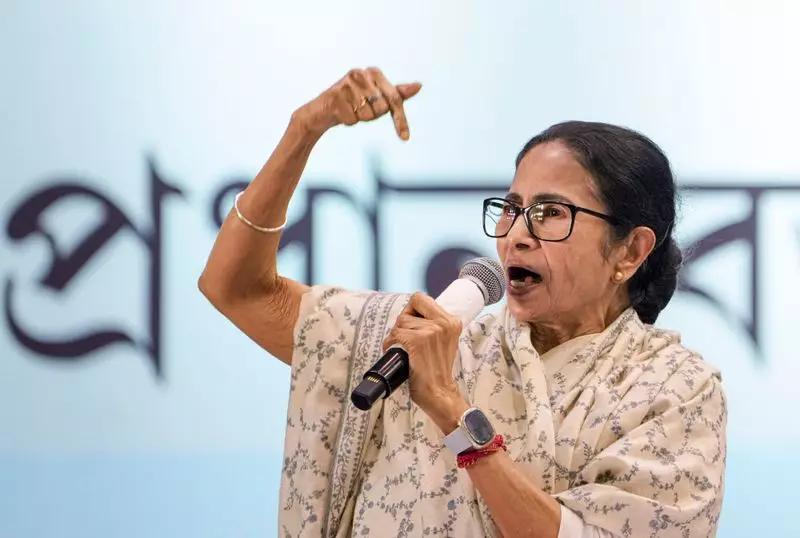
West Bengal Chief Minister Mamata Banerjee has launched a scathing attack on the Election Commission of India (ECI), alleging the presence of "gross errors" in the recently published draft electoral rolls for the state. She squarely blamed the poll body for the discrepancies, which she claims have led to the wrongful deletion of numerous legitimate voters.
Allegations of Widespread Discrepancies
Addressing the media in Kolkata, the Trinamool Congress (TMC) supremo detailed the alleged inaccuracies found in the draft rolls. She stated that the list is riddled with mistakes, including the omission of names of living voters and, conversely, the inclusion of names of deceased individuals. Banerjee emphasized that these were not minor oversights but significant blunders that could disenfranchise citizens.
The Chief Minister cited specific examples, claiming that in some cases, the names of entire families have been deleted from the voter list. She questioned the process followed by the EC officials, suggesting that the errors stemmed from a lack of proper verification and ground-level assessment. Banerjee demanded immediate and thorough rectification of these mistakes before the state heads for any future elections.

The 'Sir' Blunder and Political Implications
In a pointed critique, Mamata Banerjee highlighted a particular error that she dubbed the "Sir blunder." She explained that in many entries, the honorific "Sir" had been incorrectly recorded as part of individuals' names, leading to confusion and duplication. This, she argued, was symptomatic of a careless and automated process devoid of human scrutiny.
The timing of these allegations is politically sensitive, as West Bengal remains a key battleground state. Accusations of a flawed electoral roll often lead to charges of bias and can become a major point of contention between rival political parties. Banerjee's TMC has historically had a tumultuous relationship with the Election Commission, frequently accusing it of acting under pressure from the central government.
Banerjee urged all political parties and the general public to meticulously scrutinize the draft rolls and file claims and objections during the stipulated period. She framed the issue as one of protecting democratic rights, asserting that every citizen's right to vote must be safeguarded.
EC's Process and the Road Ahead
The publication of draft electoral rolls is a standard part of the EC's preparation for elections, allowing for a period of public verification. During this time, citizens can check their details and apply for corrections, inclusions, or deletions. The final electoral roll is published after considering all claims and objections.
While the Election Commission has not yet issued an official response to Banerjee's latest allegations, it typically maintains that its processes are robust and impartial. It encourages voters to use the statutory window to ensure their names are correctly listed.
This controversy sets the stage for a potential confrontation between the West Bengal state government and the constitutional body tasked with conducting free and fair elections. The resolution of these claims will be closely watched, as the integrity of the voter list is foundational to the electoral process. All eyes will now be on the rectification process and whether the concerns raised by the Chief Minister are addressed to the satisfaction of all stakeholders.