The political landscape of Maharashtra is witnessing significant turbulence as parties scramble to finalize their strategies for the upcoming civic body elections. The polls, scheduled for 29 municipal corporations across the state, have exposed deep fissures within and between major political alliances, setting the stage for a fiercely contested and unpredictable battle.
Alliance Equations in a State of Flux
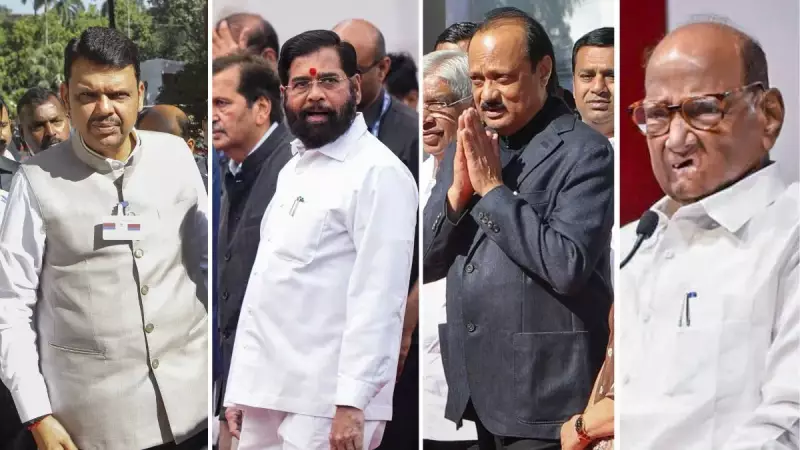
Traditional political equations that have defined Maharashtra's politics are currently in a state of disarray. The ruling 'Mahayuti' alliance, comprising the Bharatiya Janata Party (BJP), the Shiv Sena led by Chief Minister Eknath Shinde, and the Nationalist Congress Party (NCP) faction led by Deputy Chief Minister Ajit Pawar, is facing the complex task of seat-sharing. Reports suggest intense negotiations are underway, with each partner pushing for a larger share of the electoral pie, leading to friction and public disagreements.
On the opposing side, the 'Maha Vikas Aghadi' (MVA) coalition is also navigating its own challenges. The alliance between the Shiv Sena (UBT) led by Uddhav Thackeray, the Congress, and the NCP (Sharadchandra Pawar) faction must present a united front. However, the distribution of seats among these parties, each with its own strongholds and ambitions, is proving to be a delicate balancing act, causing delays in finalizing their campaign blueprint.

A Battle Across Urban Maharashtra
The scale of these elections is vast, covering major urban and semi-urban centers that are crucial for political dominance in the state. The 29 municipal corporations going to the polls represent the economic and administrative nerve centers of Maharashtra. Control over these civic bodies is not just about local governance but also about strengthening grassroots networks and influencing the state's broader political trajectory.
Key corporations like Mumbai, Thane, Pune, Nagpur, and Nashik are particularly significant prizes. In many of these cities, the battle lines are blurred. Former allies are now opponents, and past rivals are exploring cooperation, creating a complex web of contests that defies simple bipolar narratives. Independent candidates and smaller regional parties are also expected to play a decisive role in several constituencies, further complicating the electoral math for the major alliances.
Internal Strife and Strategic Gambits
Beyond inter-alliance negotiations, internal party dynamics are adding another layer of complexity. Several parties are dealing with rebellions and discontent among local-level leaders and workers who are dissatisfied with candidate selections or the overall direction of alliance talks. This internal strife threatens to dilute party cohesion at the ground level, which is critical in high-stakes local elections.
Furthermore, all political players are employing strategic gambits. Some are focusing on leveraging popular state and central government schemes, while others are highlighting local issues of infrastructure, water supply, and sanitation. The performance of sitting corporators and the anti-incumbency factor will also be pivotal in determining the outcome in many wards.
Implications for Maharashtra's Political Future
The outcome of these municipal corporation elections will have ramifications far beyond local civic issues. They are widely seen as a mid-term referendum on the performance of the ruling state government and the effectiveness of the opposition's consolidation. A strong showing will provide the winning alliance with immense momentum, organizational strength, and moral authority ahead of future assembly and national elections.
Conversely, a poor performance could trigger internal reassessments, leadership challenges, and even realignments within the political spectrum. With battle lines blurred and alliances in disarray, the campaign for Maharashtra's civic polls is poised to be a defining chapter in the state's political chronicle, one where local issues and hyper-local dynamics will ultimately shape the narrative of power.