

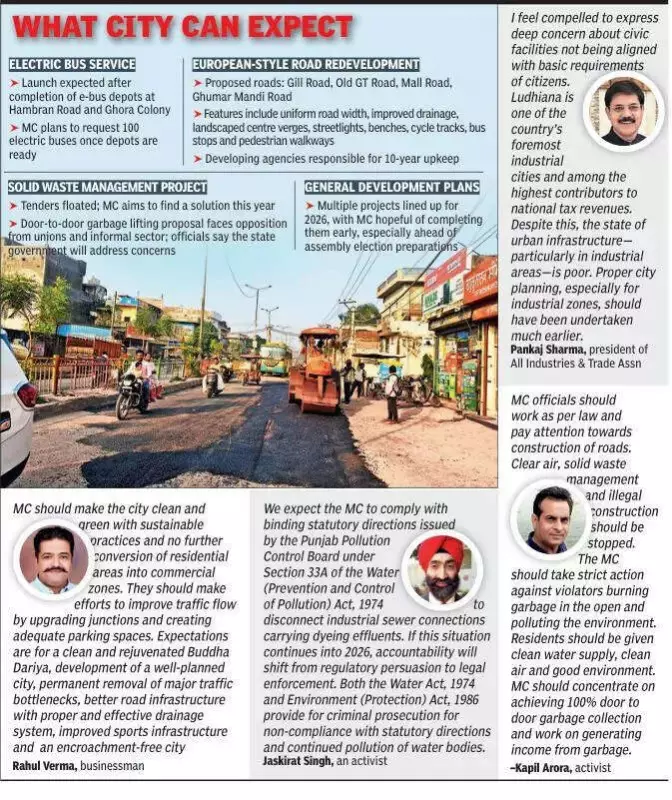
As the new year 2026 unfolds, the festive spirit lingers among Ludhiana's residents, while the city's Municipal Corporation (MC) gears up for a year packed with significant development initiatives. Officials have confirmed an ambitious agenda aimed at transforming the industrial hub, with several key projects poised for completion. The impending preparations for the state assembly elections are also expected to add momentum, potentially accelerating these public works.
Flagship Projects: Electric Mobility and Road Transformation
A major highlight on the civic body's calendar is the long-awaited launch of the electric bus service. Residents have been anticipating this eco-friendly public transport for over two years. MC officials stated that the service will become operational once the construction of dedicated e-bus depots at Hambran Road and Ghora Colony is finalized. Following this infrastructure readiness, the corporation plans to request a fleet of 100 electric buses to serve the city.
Another high-profile initiative is the plan to redevelop several prominent roads into European-style avenues. The project, currently in the discussion phase, targets Gill Road, Old GT Road, Mall Road, and Ghumar Mandi Road for a comprehensive overhaul. The redesign aims to tackle chronic traffic congestion, ensure uniform road width, and upgrade drainage systems to prevent recurring damage. The envisioned upgrades include:

- Landscaped centre verges for beautification.
- Enhanced civic amenities like modern streetlights and public benches.
- Dedicated cycle tracks and pedestrian walkways for non-motorized transport.
- Improved bus stops for better connectivity.
Notably, the agencies tasked with developing these stretches will also be responsible for their maintenance for a decade, a move officials say will ensure accountability and long-term quality.
Tackling Civic Challenges: Waste Management and Beyond
Addressing the city's persistent waste-handling crisis is a top priority for 2026. The MC has already floated tenders for a solid waste management project and hopes to finalize a sustainable solution this year. However, the proposal to privatize door-to-door garbage collection has faced opposition from workers' unions and the informal sector. Officials maintain that the state government will intervene to resolve these concerns.
MC Executive Engineer Balwinder Singh expressed optimism, stating that several projects are lined up for the year and the civic body aims to complete them as scheduled.
Voices from Ludhiana: Residents and Stakeholders Share Expectations
As the MC charts its course, citizens and industry leaders have outlined their hopes for the city's development.
Rahul Verma, a local businessman, urged the MC to focus on sustainable practices, prevent haphazard conversion of residential areas into commercial zones, and improve traffic flow through better junctions and parking. He emphasized the need for a clean Buddha Dariya, removal of traffic bottlenecks, and reliable public transport.
Activist Jaskirat Singh highlighted legal imperatives, demanding MC's compliance with Punjab Pollution Control Board orders to disconnect industrial sewer lines polluting water bodies. He warned that non-compliance could lead to criminal prosecution under environmental laws, with citizens empowered to initiate legal action.
Pankaj Sharma, President of the All Industries and Trade Association, pointed out the disparity between Ludhiana's high tax contributions and its subpar urban infrastructure. He called for world-class roads, clear waste management rules, and enhanced law and order to match the city's status as a leading industrial centre.
Activist Kapil Arora stressed the need for MC to act strictly against illegal construction, open garbage burning, and to ensure clean air and water. He advocated for 100% door-to-door garbage collection and generating revenue from waste processing.
Col (retd) J S Gill, former member of the Buddha Dariya Rejuvenation committee, focused on water security. He called for action to prevent underground water pollution, promote waste segregation, and implement rainwater harvesting to recharge the depleting groundwater table.

With a mix of large-scale infrastructure projects and pressing civic issues on its plate, Ludhiana's Municipal Corporation faces a critical year of execution. The success of these plans will be closely watched by residents eager for a tangible upgrade in their city's quality of life.





