West Bengal has become the focal point of significant religious activity, witnessing two large-scale events on consecutive days that have captured national attention. The series of gatherings underscores the deep-seated religious sentiments and political undercurrents in the state.
A Consecutive Display of Faith
The religious fervor began on Saturday, February 24, in the district of Howrah. There, a foundation stone-laying ceremony was held for a new mosque. The event was notable for its symbolic reference, as organizers explicitly modeled it on the now-demolished Babri Masjid in Ayodhya. This act immediately drew parallels to one of India's most contentious religious disputes.
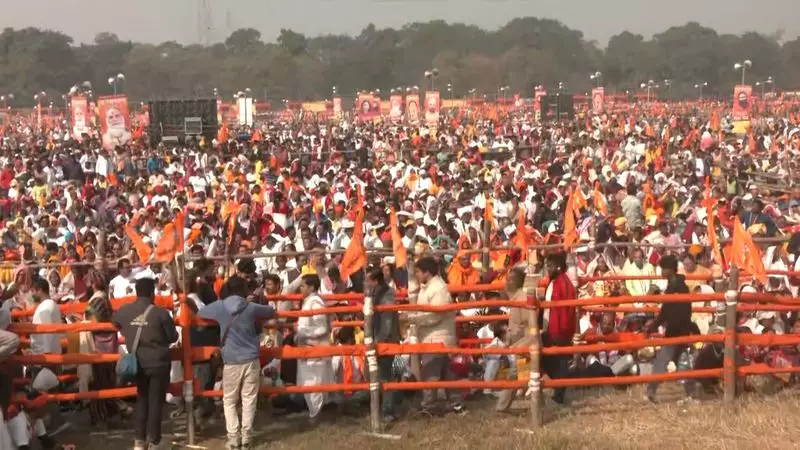
Merely a day later, on Sunday, February 25, the scene of mass congregation shifted to Kolkata's iconic Brigade Parade Ground. The venue, historically used for political rallies, transformed into a vast arena of spirituality. The occasion was the 'Gita Mahotsav,' a mega recital of the Bhagavad Gita organized by the International Society for Krishna Consciousness (ISKCON).
An estimated three to four lakh (300,000 to 400,000) devotees converged at the Maidan, creating a sea of saffron and white. Participants, including a large number of women and children, chanted verses from the sacred Hindu scripture in unison, creating a powerful and resonant atmosphere. The scale of the event was monumental, with organizers providing over 100,000 copies of the Gita for the recital.
Political Leaders and Public Participation
The Gita Mahotsav saw the presence of prominent political figures, adding a layer of political significance to the religious gathering. West Bengal Governor Dr. C.V. Ananda Bose attended the event, offering his prayers and addressing the devotees. His presence at a large Hindu religious event following the mosque ceremony was closely watched.
Furthermore, state BJP President Sukanta Majumdar and other senior BJP leaders were also in attendance. The participation of BJP leadership highlighted the party's efforts to consolidate its presence in West Bengal, a state where it has been striving to make significant electoral inroads against the ruling Trinamool Congress.
The event was not just about recitation. It featured cultural performances, spiritual discourses, and mass feasting (prasadam distribution), embodying the holistic approach of the ISKCON movement. Organizers emphasized the message of peace, duty, and righteousness from the Gita, aiming to transcend mere political narratives.
Context and Implications
The back-to-back nature of these two events has turned West Bengal, particularly Kolkata, into what observers are calling a 'religious adda' (a hub for discussion and gathering). The sequence has sparked widespread discussion on social media and among political commentators regarding the state's evolving socio-religious dynamics.
Analysts suggest that these large, symbolic gatherings reflect the increasing polarization and the competitive display of religious identity in the state's political landscape. The mosque event, with its deliberate evocation of the Babri Masjid, and the immediately following, colossal Gita recital are seen as statements of assertion by different communities.
The state administration, led by Chief Minister Mamata Banerjee, maintained a stance of ensuring law and order for both events. Security was tight at the Brigade Parade Ground, with police managing the enormous crowds to prevent any untoward incident. The peaceful conduct of both gatherings is being cited as a success for the state's security apparatus.
As the dust settles on the Maidan, the echoes of the chanted shlokas and the implications of the preceding day's ceremony continue to resonate. These two days in February 2024 have undoubtedly etched a significant chapter in West Bengal's contemporary history, highlighting how faith and politics are deeply intertwined in the public sphere. The long-term impact of this concentrated display of religious mobilization on the state's social fabric and upcoming political battles remains a subject of intense speculation.