Kolkata's Drastically Thinned Voter Rolls Inject Unpredictability into Upcoming Elections
A significantly reshaped Kolkata, with its voter rolls slashed by substantial margins, is set to head to the polls this year, introducing a level of unpredictability rarely seen in the city's electoral history. The Summary Revision of the Electoral Roll (SIR) has led to dramatic cuts, with some constituencies losing over a third of their voters, raising serious concerns about democratic representation and inclusivity.
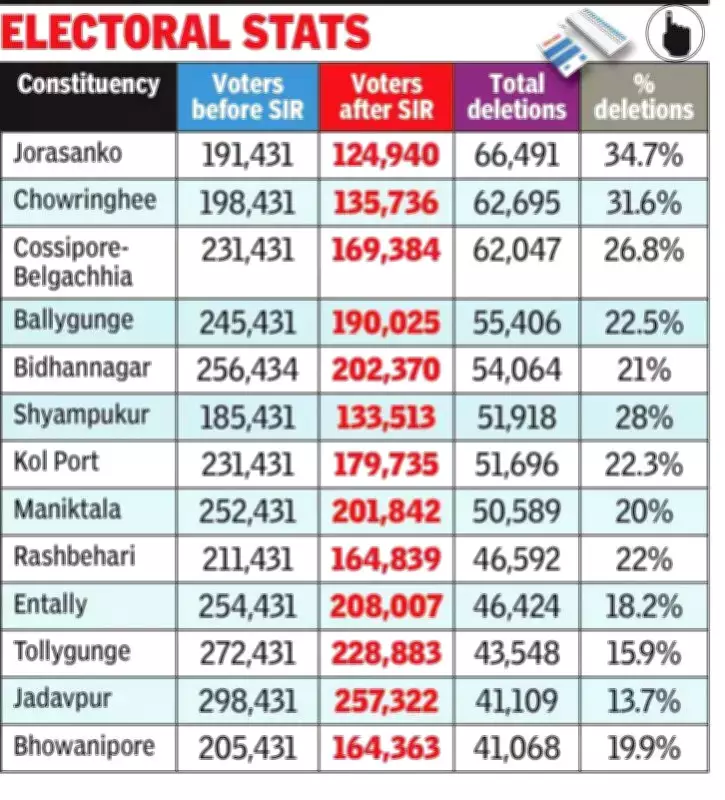
Constituencies Witness Massive Voter Deletions
Key assembly segments have been hit hard by the voter roll revisions. For instance, Jorasanko saw a staggering 35% reduction from its 1.9 lakh voters, while Chowringhee experienced a 32% cut from a similar base. Other areas like Cossipore-Belagachia, Ballygunge, Bidhannagar, Shyampukur, Kolkata Port, Maniktala, and Rashbehari all recorded over 20% of their voters marked as 'deleted'. Even constituencies with lower percentage cuts, such as Rajarhat-New Town, Tollygunge, Jadavpur, and Bhowanipore, will have over 40,000 fewer voters each on their rolls.
Migrant Voters and Women Disproportionately Affected
Sabir Ahamed, lead researcher at the Sabar Institute, highlighted that "single male migrants — who played a significant role in running the city — in urban constituencies like Jorasanko, Bhowanipore, and Kolkata Port will no longer be able to vote where they spend most of their time." Many were either deleted or forcibly re-registered in their native places. The top five Kolkata constituencies with the highest deletion rates for being untraceable or absent are Entally (59%), Jorasanko (55.1%), East Behala (47%), Jadavpur (46.5%), and Chowringhee (46.6%), areas with high non-Bengali migrant populations.
Women have also been heavily impacted. In Kolkata, women account for 42.5% of deletions in the draft roll, compared to 53.6% across the state. The analysis shows that 35% of female voter deletions were due to being 'untraceable' or 'absent', followed by 31.4% for being deceased and 31.8% for permanent shifts. The constituencies with the highest proportion of female voter deletions are Metiabruz, Rajarhat New Town, Behala Purba, Bidhannagar, and Kasba, where the average share of female deletions is 49.3%.
Minority Communities and Logical Discrepancies
The revisions have notably affected minority communities. At least 483 members of Kolkata's Chinese community, listed in the 2002 rolls, were deleted from the 2026 draft. Three-quarters of these deletions occurred in Chinatown in Tangra, spanning Entally and Kasba constituencies, with the remaining 121 from Tiretta Bazaar in Chowringhee. Around 80% were untraceable, while the rest were deceased.
While deletions due to ASDD (Absentee, Shifted, Dead, Duplicate) and unmapping lists generally align with the Muslim population share in most constituencies, logical discrepancy lists flag a disproportionately large number of Muslim voters. For example, in Bhowanipore, where Muslims constitute about 20% of the population per the 2011 Census, they account for 52% of those flagged in logical discrepancy lists.
Experts Warn of Democratic Erosion
Presidency University political science professor Zaad Mahmood expressed concern over the 60 lakh cases under adjudication, noting that "analysis by Sabar Institute and others showed that Muslims are heavily represented in logical discrepancy lists. But it is not only Muslims; it is also women. So, two politically dominant core bases of the TMC are seriously compromised, potentially facing disenfranchisement through the SIR."
Former Rabindra Bharati University VC Sabyasachi Basu Ray Chaudhury criticized the process, stating, "The exclusionary process is antithetical to the democratic spirit and culture. The hastily conducted SIR was difficult to complete on time in Bengal. It may be recalled that in 2002, when the SIR was conducted, there were no impending elections."
Implications for Kolkata's Political Landscape
The massive voter roll reductions have injected significant uncertainty into Kolkata's electoral dynamics. With key voter bases—migrants, women, and minorities—seeing substantial deletions, the upcoming polls could see shifted voting patterns and potential disenfranchisement. The SIR's timing, coinciding with election preparations, has sparked debates about fairness and inclusivity, setting the stage for a highly contested and unpredictable election season in the city.