West Bengal's Electoral Roll Sees Drastic Cuts in Kolkata Amid SIR Exercise
In a significant development, the Special Intensive Revision (SIR) exercise in West Bengal has resulted in a staggering 63.7 lakh voters being marked as 'deleted' from the electoral rolls. This process has particularly impacted Kolkata, where assembly segments like Howrah South, Jorasanko, and Chowringhee have witnessed the highest number of deletions, raising concerns about voter representation.
Kolkata Assembly Segments Bear the Brunt of Voter Hemorrhaging
The voter deletion trend was more pronounced in Kolkata compared to the rest of Bengal, with over 30% of the electorate being knocked off in the Jorasanko and Chowringhee assembly segments. Among the 10 assembly constituencies that recorded the highest reduction in electors during the SIR, six belong to the Kolkata North and Kolkata South Lok Sabha constituencies, highlighting the urban center's vulnerability.
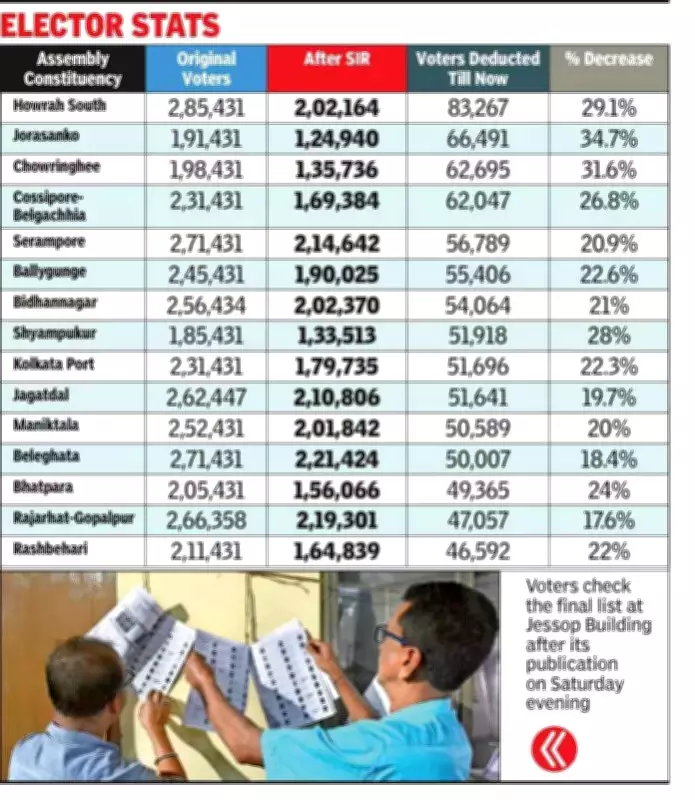
Howrah South assembly constituency tops the list with a dramatic decrease. Before the SIR exercise commenced, it had 285,431 voters, but this number has now been reduced by 83,267, representing a 29.1% decline. In Jorasanko, under the Kolkata North Lok Sabha seat, 66,491 electors were deducted, shrinking the voter base by 34.7%. Chowringhee ranks third, with its electoral count reduced by 62,695, or 32%, compared to the pre-SIR period.
Ongoing Judicial Scrutiny and Potential Increases in Deletions
The fate of another 60 lakh voters across West Bengal, including 14.4 lakh in Kolkata, hangs in the balance due to ongoing judicial scrutiny. These figures could potentially increase, as in Jorasanko, 15,307 voters are listed under the 'logical discrepancy' category, while in Chowringhee, 17,545 voters are flagged similarly, indicating further possible removals.
The 4-month-long SIR exercise also significantly affected other areas. For instance, Bidhannagar assembly constituency saw 54,064 electors wiped out from the roll, reducing its electoral base by 21% from an initial 256,434 voters. Other Kolkata assembly constituencies like Cossipore-Belgachhia, Ballygunge, Shyampukur, and Kolkata Port also secured places among the top 10 state-wide for voter depletion.
Detailed Breakdown of Voter Reductions Across Constituencies
- Cossipore-Belgachhia: Reduced from 231,431 to 169,384 electors.
- Ballygunge: Electorate fell by 55,406, from 245,431 to 190,025.
- Shyampukur and Kolkata Port: Voter numbers reduced by 51,918 and 51,696, respectively.
- Maniktala: Witnessed a 20% fall in electors.
- Beleghata: Now has 221,424 voters, down from 271,431.
- Rashbehari: Voter count dropped to 164,839 from 211,431.
- Entally: Now has 208,007 electors, down from 254,431.
- Rajarhat-New Town: Reduced by 14%, from 320,097 to 275,301 electors.
In other assembly constituencies like Behala Purba, Tollygunge, Dum Dum, Jadavpur, and Behala Paschim, net voter deductions ranged from 36,899 to 44,532, further illustrating the widespread impact of the SIR exercise.
Mechanisms and Trends Behind the Deletions
The deletion trend first became evident on the December 16 draft SIR list. In the Jorasanko assembly segment, the voter list shrank by a massive 36.8%, the highest in Bengal, with 37,193 voters untraceable and 16,364 shifted elsewhere. Similarly, in Chowringhee, 74,553 voters were axed from the draft electoral roll, with 35,042 untraceable and 25,053 relocated.
Assembly segments with high deletion rates share a common feature: a large number of untraceable and relocated voters. Despite additions in the final voter list published on Saturday, the overall trend remained unchanged, with an additional 25,000 electors in Kolkata North and Kolkata South parliamentary constituencies excluded from the final lists.
According to Election Commission data, 17,987 electors were deleted in Kolkata North, while 7,386 were removed across the seven assembly segments under the Kolkata South Lok Sabha seat. Voters marked as 'deleted' can now only file applications as new voters under Form 6, allowed until the last day of filing nominations, adding a layer of complexity to the electoral process.