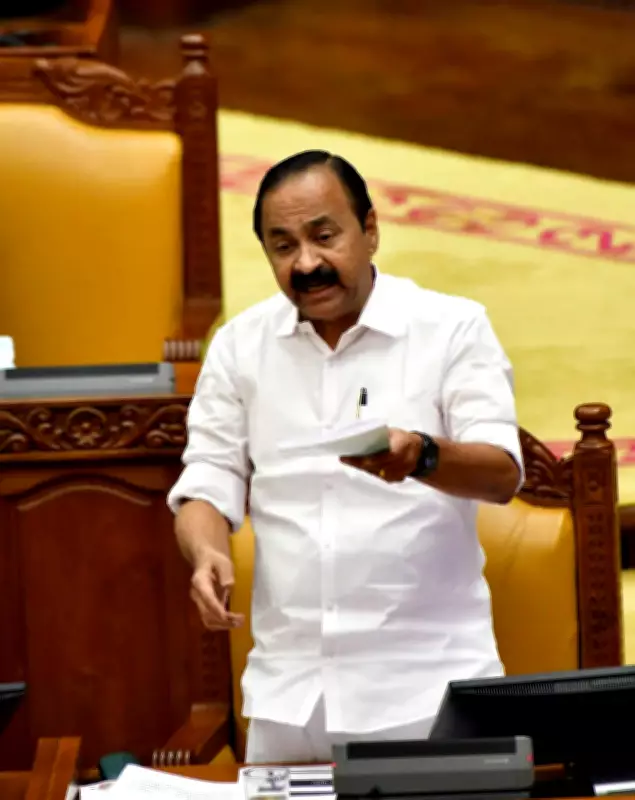
The UDF government inherited outstanding liabilities of Rs 5.07 lakh crore, equivalent to 35.5 percent of Kerala's gross state domestic product (GSDP), along with accumulated payment arrears of Rs 48,733 crore, according to a fiscal status report tabled in the assembly by Chief Minister V D Satheesan on Thursday. The report also noted that committed expenditure consumed nearly 77 percent of the state's total revenue receipts.
The white paper, described as a candid assessment of Kerala's fiscal condition, said the state was grappling with mounting debt, growing payment arrears, recurring treasury stress, and shrinking fiscal space for development spending. Prepared as a baseline assessment at the start of the government's tenure, the report said Kerala had increasingly moved away from the principle that borrowings should finance productive investment. Despite recording one of the highest fiscal deficits among Indian states, Kerala's capital expenditure stood at only 1.3 percent of GSDP, less than half the national average.
Root Causes of Fiscal Stress
The report attributes the state's fiscal stress to high committed expenditure, declining central transfers, weak revenue growth, off-budget liabilities linked to the Kerala Infrastructure Investment Fund Board (KIIFB), and losses at public sector enterprises. Expenditure on salaries, pensions, and interest payments routinely exceeded the state's open market borrowings.

Treasury Management Woes
One of its starkest findings relates to treasury management. It noted that the state increasingly depended on the Reserve Bank of India's liquidity support mechanisms, including ways and means advances (WMA) and overdrafts, whenever revenues fell short of expenditure commitments. While Kerala has relied on WMA every year since 2015, the dependence intensified during the Covid-19 period and later in 2024-25. In 2025, the state remained under WMA for 262 days and under overdraft for 84 days, compared with 125 days and 67 days, respectively, in 2024.
Payment Arrears and Budget Credibility
The report also pointed to a substantial backlog of legally due payments that were deferred to ease treasury pressures. These include Rs 21,670 crore in dearness allowance arrears for government employees and Rs 14,387 crore in dearness relief arrears for pensioners. Payments due to banks and contractors under bill-discounting arrangements total Rs 3,431 crore. Total pending obligations amount to Rs 48,733 crore, a sum almost equivalent to the state's annual net borrowing capacity.
The white paper raised concerns about the credibility of budget projections over the past decade, citing persistent gaps between estimates and actual outcomes. Actual state tax revenues routinely fell about 10 percent short of budget estimates, while revenue and fiscal deficits repeatedly exceeded projected levels. The white paper further noted that plan expenditure often appeared to exceed budget estimates because actual spending included expenditure routed through KIIFB and certain public sector enterprises that was not reflected in budget projections. It described the practice as a form of financial "sleight of hand" that hindered a realistic assessment of the state's fiscal position.
KIIFB and Public Sector Enterprises
The report said KIIFB could no longer function as an independent borrowing vehicle. It also noted that Kannur, Thiruvananthapuram, and Ernakulam together accounted for nearly half of its project allocations, and questioned whether such concentration was justified by economic need or development indicators.
The white paper put the number of public sector enterprises in Kerala at 132 — the highest among Indian states — and said their accumulated losses rose from Rs 31,571 crore in 2021-22 to Rs 78,851 crore in 2024-25. KSRTC, Kerala Social Security Pensions Ltd (KSSPL), and Kerala Water Authority accounted for 72 percent of these losses in 2024-25.
Proposed Reforms
It called for a shift from production-based to consumption-based subsidies and suggested the disinvestment, privatisation, or closure of non-strategic public sector enterprises. It also proposed merging Kerala State Beverages Corporation and Civil Supplies Corporation into a single entity with separate divisions, enabling losses in the latter to be offset against profits generated by the other.

The white paper said plan expenditure stagnated in nominal terms, accounting for less than 18 percent of total expenditure by 2025-26. It also pointed to a sharp decline in welfare spending for SC, ST, OBC, and minority communities, whose share of total plan expenditure fell from 9.24 percent in 2017-18 to 3.85 percent in 2025-26.