In Jharkhand, a fierce political and social debate has erupted over the Centre's proposed VB-G RAM G Act, which seeks to replace the two-decade-old Mahatma Gandhi National Rural Employment Guarantee Act (MGNREGA). Labour rights groups and the opposition Congress have launched protests, warning of severe consequences for rural livelihoods, while the ruling BJP defends the move as a necessary step to eliminate corruption and modernize the rural jobs scheme.
Activists Decry 'Bulldozer Act', Fear Migration and Exclusion
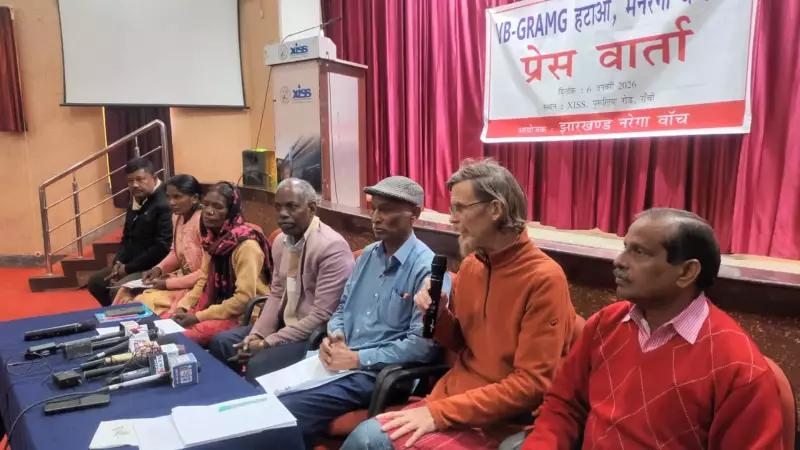
On Tuesday, January 6, 2026, members of the Jharkhand NREGA Watch held a press conference in Ranchi, sharply criticising the Viksit Bharat – Grameen Rozgar Aur Aajeevika Mission Guarantee (VB-G RAM G) legislation. They labelled it a "bulldozer Act" that demolishes the legal right to work by repealing MGNREGA and replacing it with a centrally controlled scheme.
Prominent economist Jean Drèze, addressing the media, outlined multiple concerns. He pointed to a "switch-off clause" that allows the central government to start or stop the scheme at its discretion, fundamentally undermining the guarantee of work. Drèze also highlighted a shift in the funding mechanism, where the Centre will fix state-wise allocations, ending the open-ended, demand-driven funding of MGNREGA and pushing more financial burden onto states.
"Drawing from past experience under NREGA, such digital systems have led to delayed, blocked and rejected wage payments, and could further exclude workers, especially in rural areas with poor connectivity," Drèze cautioned, noting the Act's heavy reliance on digitisation, biometrics, AI, and facial recognition.
James Herenj, coordinator of Jharkhand NREGA Watch, warned that the Act would intensify distress migration from Jharkhand, a state already heavily dependent on MGNREGA. Activists specifically flagged the proposed 60-day work suspension during peak monsoon, a period historically linked to starvation deaths, stating it would hit the state's most vulnerable—women, the elderly, disabled, and SC/ST communities—the hardest.
Political Battle: Congress Protests, BJP Counters with Corruption Charges
The political divide over the issue was starkly visible. On Monday, the Jharkhand unit of the Congress held a statewide "Save MGNREGA" protest, which culminated at Raj Bhavan in Ranchi.
In a swift counter, BJP Jharkhand president and Leader of the Opposition Babulal Marandi held a press conference on Tuesday. He accused the Congress of being "confused, frustrated and demoralised" and trying to mislead the public. Marandi alleged that MGNREGA had become a centre of corruption and financial irregularities, citing an alleged Rs 24-crore embezzlement case in Khunti district and similar issues across the state.
He defended the new VB-G RAM G Act, stating it was aligned with the goals of Viksit Bharat 2047. "Guaranteed employment would increase from 100 to 125 days annually," Marandi claimed, with a focus on water conservation, rural infrastructure, and climate-resilient works.
New Provisions and Assurances Under VB-G RAM G
Outlining the proposed framework, Babulal Marandi listed several features aimed at increasing transparency and efficiency:
- AI-based fraud detection and GPS-enabled monitoring.
- Central and state-level oversight committees.
- Weekly public disclosures and mandatory social audits twice a year in every panchayat.
- A 60-day no-work period during peak agricultural seasons.
- Payment of unemployment allowance if work is not allotted.
- A Centre–state funding ratio of 60:40.
Marandi accused the Congress of being anti-village and anti-poor, suggesting the party was uncomfortable with the corruption crackdown, the increase in work days, and even the use of the word "Ram" in the scheme's name. He vowed that BJP workers would take the provisions of the new law to the public to counter what he called Congress's misinformation.
Meanwhile, Jean Drèze stated that his group would approach the Jharkhand government to build pressure during the upcoming Budget session of the Legislative Assembly to pass a resolution opposing the VB-G RAM G Act, following the examples of states like Punjab and Karnataka. The ruling Jharkhand Mukti Morcha's general secretary, Vinod Pandey, when contacted, declined to comment immediately.