In a firm stance against the central government's proposed overhaul of the rural jobs scheme, Jharkhand Chief Minister Hemant Soren declared on Tuesday that the state is unlikely to accept the new VB-G-Ram-G Act. He labeled the Centre's move to repeal the existing Mahatma Gandhi National Rural Employment Guarantee Act (MGNREGA) as a direct interference with the scheme's "soul."
A Direct Attack on Rural Rights
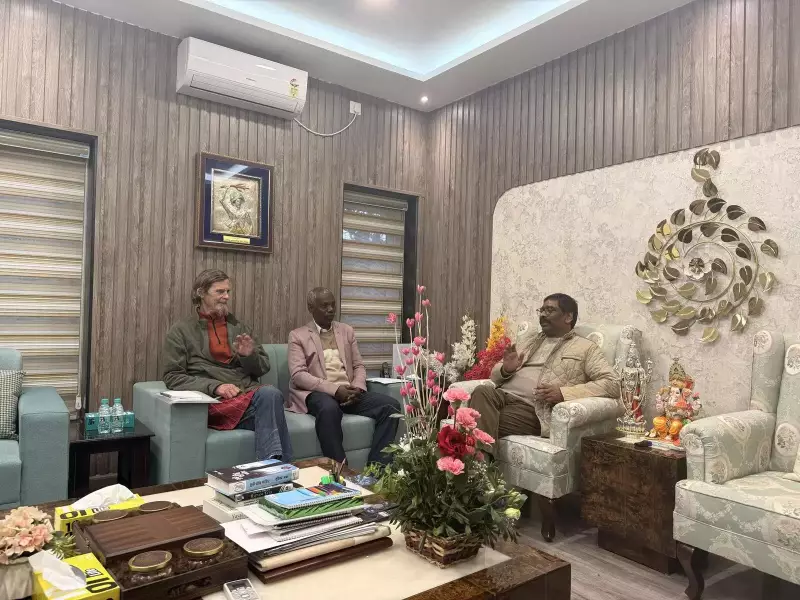
The Chief Minister's strong remarks came after a crucial meeting with renowned economist and MGNREGA architect Jean Dreze, and James Herenj, convenor of the Jharkhand MGNREGA Watch. Soren emphasized that any compromise on wages, work guarantee, and states' rights is unacceptable. "Tampering with the soul of MGNREGA will never be acceptable," Soren stated, clarifying that the central government's changes constitute a direct attack on the rights of the rural poor.
Massive Fiscal Burden on Jharkhand
Echoing the Chief Minister's concerns, State Finance Minister Radha Krishana Kishore projected a daunting financial implication for Jharkhand. He anticipated that the VB-G-Ram-G Act would impose an additional annual fiscal burden of approximately Rs 5,640 crore on the state.

Kishore explained the shift in fund-sharing: under the new Act, the Centre and state would share expenses in a 60:40 ratio. This is a stark contrast to the existing MGNREGA framework, where the central government bears 100% of the wage cost, with the state contributing only 25% for materials. With around 40 lakh active MGNREGA workers in Jharkhand, the wage requirement at Rs 282 per day for 125 days would be about Rs 14,100 crore. The state's 40% share of this amount translates to the staggering Rs 5,640 crore figure, an unwanted strain for an economically backward state.
The Finance Minister also raised serious questions about the Centre's budgetary preparedness. With 12.16 crore registered MGNREGA workers nationwide, the annual wage requirement would be around Rs 3.80 lakh crore. "Ironically, for the 2025-26 fiscal year, the Centre has only allocated Rs 86,000 crore for MGNREGA," Kishore noted, casting doubt on the government's commitment to large-scale funding in subsequent years.
Risk of Migration and Agricultural Impact
State Rural Development Minister Deepika Pandey Singh, whose portfolio includes MGNREGA, warned of severe social consequences. She stated that the impractical clauses of VB-G-Ram-G could increase the risk of migration, starvation, and social insecurity for Jharkhand's large population of landless labourers. Furthermore, she highlighted that the new Act would adversely affect the agriculture and horticulture-based schemes currently operating successfully under MGNREGA in the state.
In response to the central move, Minister Singh has already directed her officials to prepare an action plan to further strengthen and expand MGNREGA's implementation within the next six months, signaling the state's intent to protect the existing framework.