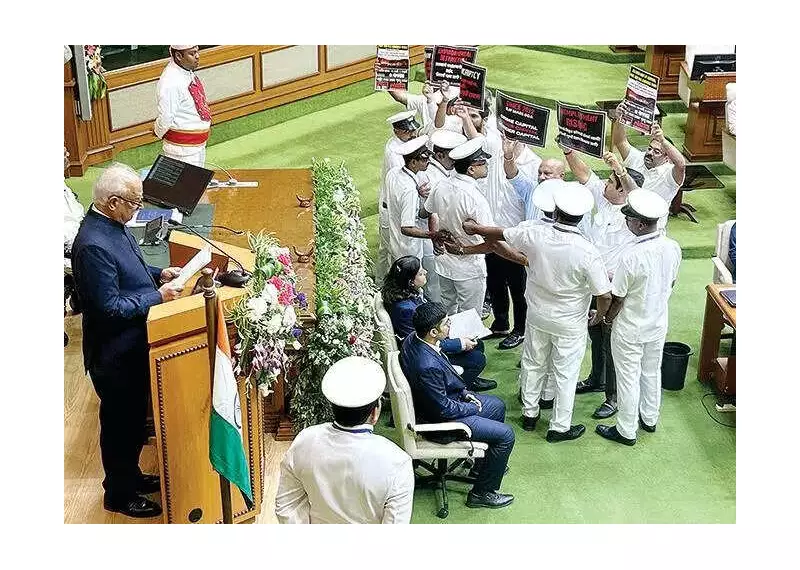
Goa Governor's First Assembly Address Sparks Opposition Protest
Governor Pusapati Ashok Gajapathi Raju delivered his first customary address in the Goa legislative assembly. His 84-page speech lasted for two hours. However, the address notably avoided discussing several pressing issues facing the state.
The speech did not mention rampant hill-cutting activities. It also skirted around widespread land conversion problems. Most significantly, it failed to address the violations that led to the tragic fire at the Birch nightclub in Arpora. That incident claimed 25 lives.
Opposition MLAs Disrupt Proceedings
The assembly session began on a disruptive note. Opposition MLAs immediately swarmed into the well of the House. They protested the governor's silence on the Birch nightclub tragedy.

Opposition leader Yuri Alemao demanded a statement about the fire. The incident broke out at Birch by Romeo Lane in early December. All seven opposition MLAs then rushed forward. Marshals had to escort them out of the chamber to restore order.
Only towards the end of his speech did Raju express sorrow. He mentioned deaths "in the tragic stampede at the Lairai Devi Jatra in Shirgao, the Arpora fire incident, and human lives lost in road accidents."
Governor Praises Police, Outlines Development Plans
With silence prevailing after the protest, Raju continued his address. He gave a clean chit to the Goa police. Raju stated that law and order remains "under control" in the state.
"This is proved by the fact that Goa maintains a high crime detection rate of 87.7%," said Raju. He emphasized that individuals involved in criminal activities are apprehended through collaborative efforts.
The governor said the government is committed to robust vigilance and citizen-focused policing. He also announced that Goa remains on track to become a developed state by 2037.
"The preparation of Vision Document Viksit Goa @ 2037 is in its final stages of completion," Raju stated. He explained that this document will act as an all-inclusive, long-term blueprint for transforming Goa.
Addressing Specific State Issues
Raju acknowledged the "serious problem of stray cattle" that leads to road accidents. He said the government is working with panchayats and civic bodies to relocate stray cattle to gaushalas effectively.
"Ten local bodies have availed the Goa Stray Cattle Management Scheme, incurring an expenditure of Rs 9.7 crore," he revealed.
The governor also discussed administrative reforms. He said the creation of a third district will strengthen administrative efficiency. This move will bring governance closer to the people by reducing the workload on existing districts.
Raju highlighted the Mhaje Ghar scheme designed to address the plight of landless persons. He spoke about the resumption of iron ore mining in Goa. The government earned Rs 252.8 crore as an upfront payment after auctioning 12 mining blocks.
"Five of the blocks have begun extracting ore," said Raju. "The remaining seven blocks are in the process of obtaining environmental clearances and other permissions."
The fourth round of auction for mining blocks is also planned. An e-auction of 10 mining dumps is on the anvil as well.
Technology and Cultural Initiatives
Raju announced that the government plans to launch a new app. This application will allow people to register grievances and complaints directly.
His speech also touched upon Goa's dying traditional skills and cultural practices. The government aims to document and revive some of these skills.
"My government is in the process of designing a system to incorporate our Goan artisans engaged in traditional occupations into a formalised set-up," Raju explained. "The process to identify the existence of 71 traditional occupations or businesses, so as to create a database, is under process."
The governor's comprehensive address covered several other areas. These included cybercrime prevention, education reforms, rural development programs, skill development initiatives, industrial and investment growth strategies, and waste management solutions.
Raju concluded by mentioning an innovative plan. The state is developing a 'happiness index' to measure and improve citizen well-being.