

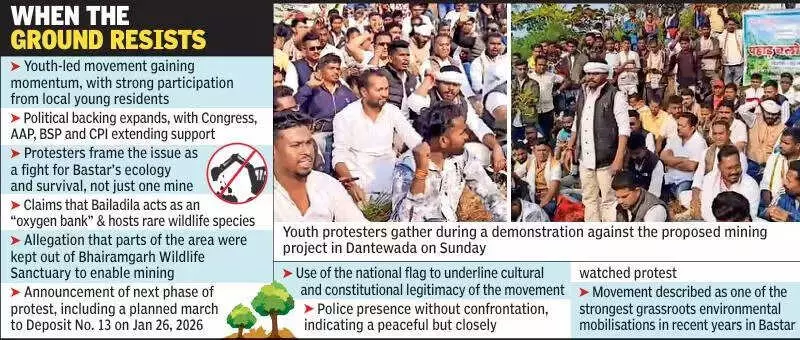
Fresh Wave of Protests Engulfs Bailadila Hills
A new wave of protests has erupted in the Bailadila hills located in Chhattisgarh's Dantewada district. Local youth, joined by several political parties, have launched a fresh agitation. Their primary demand is to stop the proposed mining of deposit number 4 and oppose alleged moves to hand it over to private entities.
Bike Rally and Hilltop Sit-In Mark Protest
The agitation gained momentum on Sunday with dozens of young protesters organizing a large bike rally. Following the rally, participants trekked several kilometres up the hill to stage a sit-in demonstration. At the hilltop, they raised powerful slogans demanding the protection of Bastar's "jal-jungle-zameen" (water-forest-land).
What began as a youth-led movement quickly garnered support from major political players. The Congress, Aam Aadmi Party (AAP), Bahujan Samaj Party (BSP), and the Communist Party of India (CPI) have all extended their backing to the protesters. Leaders from these parties affirmed that the protests would continue until their demands are met.

Leaders Vow to Continue the Ecological Fight
Addressing the gathering at the protest site, local Congress leader Chhavindra Karma framed the struggle as a battle for survival. He emphasized that the issue transcends a single mining lease. "These forests and hills give life to Bastar. We have launched this fight to save them," Karma declared. He announced an escalation of the movement, stating that the protest against mining would extend from deposit number 4 to deposit number 13.
In a significant announcement, Karma revealed that protesters plan to march to Deposit number 13 on January 26, 2026, marking the next major phase of their agitation.
Concerns Over Biodiversity and "Oxygen Bank"
Youth leader Rahul Mahajan highlighted the critical ecological value of the Bailadila landscape. He described the area as a habitat for several rare species and a natural oxygen bank for the entire Bastar region. Mahajan leveled serious allegations against the authorities, claiming the area was deliberately excluded from the Bhairamgarh wildlife sanctuary boundary to facilitate mining, despite being a frequent corridor for wildlife.
"The community believes the government is determined to destroy the hills for commercial gain, ignoring the environmental consequences," Mahajan stated. He warned that any excavation would cause irreversible damage to the fragile ecosystem, a risk the protesters are committed to preventing.
Protesters, many carrying the national flag, expressed that their resistance is deeply rooted in protecting the cultural and ecological identity of Bastar, which they believe is inseparable from Bailadila's hills, rivers, and forests.
Police Monitoring and Broader Implications
While slogans echoed across the hilltop with vows to intensify the agitation in the coming weeks, police personnel monitored the situation from a distance. No untoward incidents were reported till evening.
This mobilization represents one of the strongest grassroots environmental movements in the region in recent years. It marks a significant political and social pushback against mining expansion in Bailadila, a region perennially caught in the complex debate between development, tribal rights, and environmental conservation.






