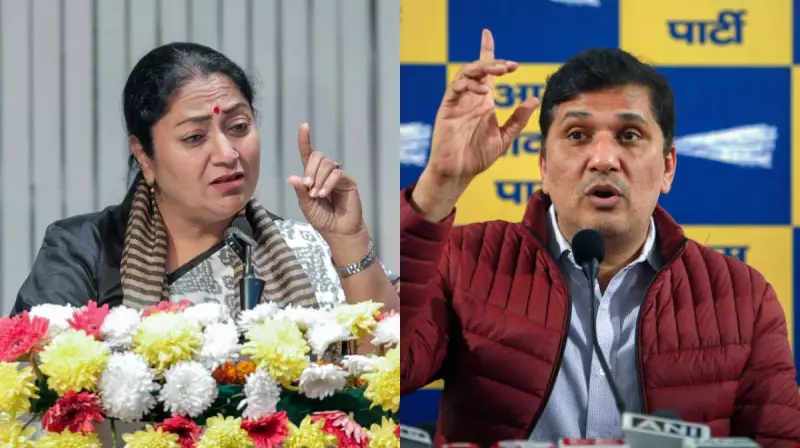
A fresh political storm has erupted in the national capital over the handling of stray dogs, leading to a police case and sharp exchanges between the Aam Aadmi Party (AAP) government and the Lieutenant Governor's (LG) office. The controversy escalated after Delhi Health Minister Saurabh Bhardwaj claimed on social media that he faced threats following an order related to stray dog management.
The Trigger: A Social Media Post and Subsequent FIR
The chain of events began when AAP minister Saurabh Bhardwaj took to microblogging platform X (formerly Twitter) on January 2, 2026. In his post, Bhardwaj stated that he had issued an order to the Municipal Corporation of Delhi (MCD) concerning the implementation of Animal Birth Control (ABC) rules for stray dogs. He alleged that after issuing this directive, he received threats, prompting him to approach the police.
Following his complaint, the Delhi Police registered a First Information Report (FIR) against unknown persons. The case was filed under relevant sections of the Indian Penal Code pertaining to criminal intimidation and acts done by several persons in furtherance of common intention. The police have initiated an investigation based on the minister's allegations.

Clash Over Authority and the GNCTD Act
At the heart of this conflict lies a tug-of-war over administrative authority. The LG's office swiftly countered Minister Bhardwaj's claims. Officials from Raj Niwas clarified that the order in question, pertaining to the MCD and stray dogs, was issued without the mandatory approval of the Lieutenant Governor, Vinai Kumar Saxena.
They emphasized that as per the Government of National Capital Territory of Delhi (GNCTD) Act and the Supreme Court's interpretation, the elected government must seek the LG's approval on matters falling outside the purview of the Delhi Assembly. The Raj Niwas statement asserted that the order was therefore "illegal and void ab initio" (invalid from the outset). This legal standpoint forms the core of the LG office's objection to the minister's action.
Political Reactions and the Bigger Picture
The AAP has framed the incident as an attempt to intimidate its ministers and obstruct the elected government's work. Party leaders have accused the LG's office of overstepping its bounds and creating hurdles in governance, especially in civic issues like stray animal management that directly impact Delhi's residents.
Conversely, sources close to the LG's office maintain that due process and constitutional propriety must be followed. They argue that the minister's public posturing bypasses established channels and creates unnecessary confusion. This incident is seen as the latest flashpoint in the ongoing and often contentious power-sharing dynamic between the elected Delhi government and the centrally appointed Lieutenant Governor.
The issue of stray dog management is itself a sensitive and persistent challenge in Delhi, involving public safety, animal welfare, and municipal effectiveness. The political clash over the authority to issue orders on this matter has now added a complex legal and administrative layer to the problem, potentially delaying concrete action on the ground.
The Delhi Police's investigation into the threats mentioned by Saurabh Bhardwaj is ongoing. Meanwhile, the fundamental question of which authority—the elected council of ministers or the Lieutenant Governor—holds the reins on specific administrative matters in Delhi remains a contested and unresolved debate, with this stray dogs order becoming its newest focal point.