Punjab Farmers Accuse Government of 'Selective' Satellite Surveillance Following Devastating Crop Loss
Farmers in the Majitha region of Amritsar district have voiced profound shock and mounting frustration over what they describe as the government's "selective use" of satellite technology. They argue that while authorities swiftly deploy officials and police to villages for stubble burning violations using real-time satellite imagery, the same rapid administrative response is conspicuously absent when natural disasters like hailstorms and heavy rains destroy their livelihoods.
"Is the Satellite Only Working Against Us?" Farmers Demand Answers
The aggrieved farming community is now raising a poignant question: "Is the satellite only working against us, not for us?" While the Meteorological Department routinely issues weather warnings, farmers' anger is directed at the administration's failure to respond to the subsequent crop devastation with comparable urgency.
Farmer organizations have mobilized to support affected communities, demanding the government immediately commence 'girdavari' – the official crop loss assessment process – and announce adequate financial compensation for the losses incurred.

Personal Stories of Devastation Highlight Administrative Apathy
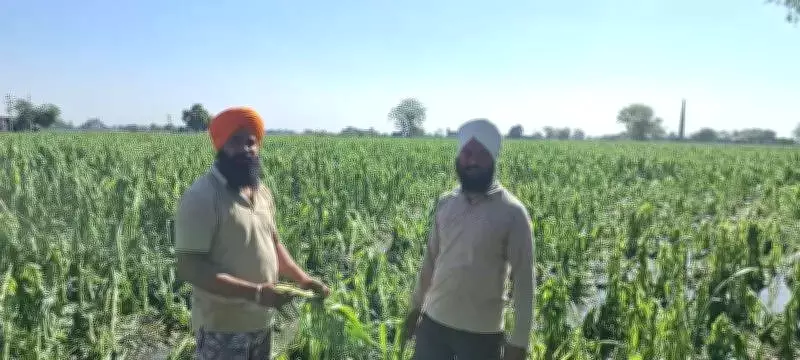
Satinder Pal Singh, a farmer from Hariya village, embodies the devastation. His maize, wheat, and tomato crops were completely wiped out by recent hailstorms and unseasonal rains. Having sown maize across 17 acres, Satinder now faces total loss with no government assistance in sight.
"Not a single official has come to assess our losses," he said, his voice thick with frustration and helplessness. He contrasted this with the immediate response to stubble burning, recalling how police and officials rushed to his village when a nearby farmer burned residue, citing satellite imagery, resulting in an on-the-spot ₹5,000 fine and legal proceedings requiring bail.
"Is the satellite not working now? Or has the government shut it off and gone to sleep?" Satinder remarked. "The officers who came running over stubble burning should come and see for themselves the destruction caused by the hailstorm and rain."
Echoes of Frustration Across Farming Communities
Manpreet Singh from Idgah village echoed identical sentiments, reporting 60-70% crop loss for his family without a single government visit to his fields. "The last time, when a small amount of stubble was left burning in a nearby field, officials came running and fined me ₹2,500 on the spot. Now where is that satellite? Why can it not see the losses caused by the hailstorm and rain this time?" Manpreet questioned.
Farmer Leaders Step In, Demand Immediate Action
Sarwan Singh Pandher, a senior leader of the Kisan Majdur Sangharsh Committee Punjab, visited the affected villages with his team to assess the situation. He confirmed that recent hailstorms and unseasonal rains caused devastating losses to wheat, maize, and vegetable crops across the region.
Pandher reiterated the farmers' central question: "Where is the satellite now? Is it not showing the government the losses suffered by these farmers?" He demanded immediate 'girdawari' and urged the government to announce compensation of ₹70,000 per acre, plus additional special compensation for vegetable crop losses, without further delay.
The situation highlights a growing perception among Punjab's agricultural community of unequal application of technology and administrative resources, where surveillance tools are deployed for enforcement but not for welfare, creating deep-seated resentment in rural areas already struggling with climate variability and economic pressures.