DMDK's Aggressive Seat Demands Stall Tamil Nadu Alliance Negotiations
In Chennai, the Desiya Murpokku Dravida Kazhagam (DMDK) has adopted a firm stance during ongoing alliance discussions, actively pushing for a significantly larger allocation of seats. This assertive approach has notably delayed final decisions regarding coalition formations in the state. The party's public demands have been prominently voiced by Vijaya Prabhakaran, the son of the late founder Vijayakant, over recent days.
Public Demands and Justifications
Vijaya Prabhakaran has explicitly stated the DMDK's requirement for 20 assembly seats. He articulated this position at a gathering in Krishnagiri, emphasizing, "The 20 seats that we are asking for are not only for us to win power, but also to help bring you to power." Additionally, party chief Premallatha Vijayakant is reportedly insistent on securing a Rajya Sabha seat as a component of any alliance agreement.
DMDK leaders defend these demands as justified. They argue that a sympathy wave following Vijayakant's demise has consolidated previously lost support and attracted new voters. Vijaya Prabhakaran pointed to the 2021 assembly election, where victories in several constituencies were determined by narrow margins of 5,000 votes or less. He contended that the DMDK polled more votes than these margins in many segments, asserting, "In tight contests, the alliance that has DMDK will win."

Opposition and Analyst Perspectives
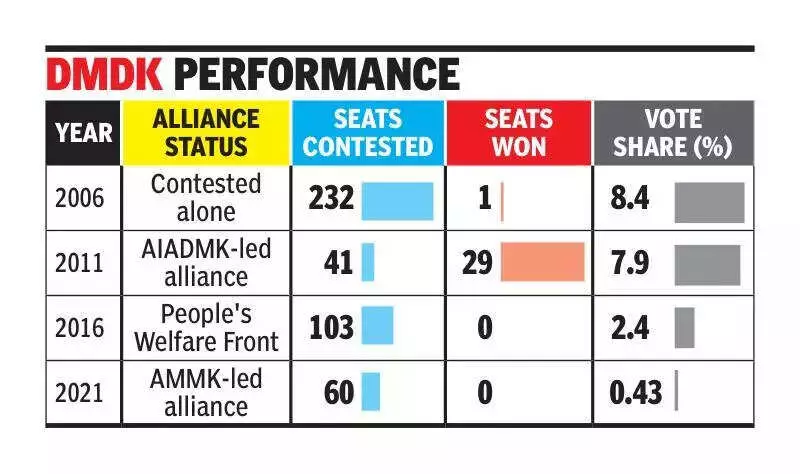
However, leaders from both the DMK and AIADMK have characterized the DMDK's expectations as high and disproportionate to the party's current electoral strength. They highlight that the DMDK secured merely 0.4% of the vote share in the 2021 assembly elections, questioning the basis for such substantial demands.
Political analysts largely view the DMDK's stance as unrealistic. Analyst R Deepak explained that the DMK-led front is largely finalized, with allies like Congress, VCK, Left parties, IUML, and MDMK all signaling intentions to seek more seats than in 2021. He noted, "MNM has also joined the DMK front. DMK will be reluctant to cut down from the 173 seats the party itself contested in 2021." On the NDA-AIADMK front, space for allies has constricted following the return of the AMMK. Deepak concluded, "Therefore, only a single-digit seat allocation for DMDK is likely."
Historical Context of DMDK's Bargaining
The DMDK's current hard bargaining is not without precedent. The party has a history of ambitious seat negotiations:
- In 2011, it initially sought 50 seats but ultimately settled for 41 in an alliance with the AIADMK, during a period when Vijayakant was a formidable political force.
- Subsequently, the party's performance has seen a steady decline. A significant drop in vote share occurred in 2016 when the DMDK aimed ambitiously for the Chief Minister's position.
- In 2021, the party initially demanded 41 seats again, later reducing the ask to 23 before exiting talks to align with AMMK—a move that resulted in the meager 0.4% vote share.
Internal Confidence and Future Outlook
Despite external skepticism, DMDK leaders reject notions that their political leverage has diminished. Former DMDK MLA B Parthasarathy stated, "Even two years after Vijayakant's death, we see our support growing in villages." He mentioned that Premallatha Vijayakant, who is actively campaigning across Tamil Nadu, is expected to return to Chennai in the first week of February, by which time alliance arrangements are anticipated to be finalized.
The ongoing negotiations underscore the complex dynamics of coalition politics in Tamil Nadu, where historical performance, perceived strength, and strategic positioning continue to influence seat-sharing discussions ahead of crucial electoral battles.