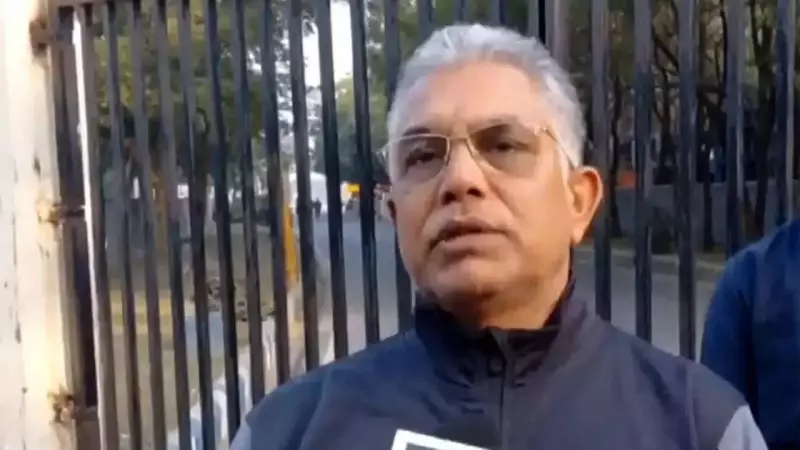
Senior Bharatiya Janata Party (BJP) leader Dilip Ghosh has ignited a fresh controversy within the party's West Bengal unit, just a day after what was seen as his political rehabilitation in the presence of Union Home Minister Amit Shah. Ghosh, a former state president, made pointed remarks questioning the party's reliance on religious politics and took indirect swipes at new members, deepening existing internal rifts.
Direct Critique of Electoral Strategy
On Thursday, Ghosh made a bold statement that is likely to raise eyebrows in the party's central leadership. He asserted that "Mandir-masjid politics will not help increase the BJP's vote." To substantiate his claim, he pointed to the party's performance in the 2024 Lok Sabha elections around Ayodhya. "Mandir-masjid issues do not impact poll results; the BJP would not have lost Faizabad (if that were so)," he argued. He extended this logic to West Bengal, stating it would be equally "wrong to assume" that Chief Minister Mamata Banerjee would win the assembly election merely by constructing temples.
Barbs at 'Recent Entrants' and Election Setback
Ghosh did not stop at criticizing the party's campaign strategy. He also took aim at "recent entrants" to the BJP, emphasizing the need to understand the party's culture. While he did not name anyone, his comments are widely seen as directed at former Trinamool Congress heavyweight Suvendu Adhikari, who joined the BJP just before the 2021 assembly polls and has since risen significantly.

He also voiced his discontent over his own candidacy in the 2024 Lok Sabha polls. Ghosh, who began his career in undivided Midnapore, was moved to contest from the Burdwan-Durgapur constituency, where he faced defeat. "Was there any need for the party to nominate me from that seat? Everyone saw what happened," he remarked, highlighting his sense of being sidelined.
Isolation and a Path Forward
Ghosh openly discussed his period of isolation within the party, revealing that he was kept away from central leaders like Amit Shah and PM Modi during their recent Bengal visits. He met Shah on Wednesday, marking his first interaction with a central leader in months. "Baseless agenda-driven theories were floated and I was isolated," he stated, but expressed faith in the central leadership to address his concerns.
In a meeting with current state BJP president Samik Bhattacharya on Thursday, Ghosh expressed his desire to contest from his "home seat" of Kharagpur in the crucial 2026 assembly elections. He sought permission to begin a three-day campaign in Kharagpur starting Saturday, signaling his intent to reclaim his political base.
Ghosh also defended his May 2025 visit to the Jagannath Mandir in Digha, where he met CM Mamata Banerjee—an act for which he faced internal criticism. "The temple does not belong to anyone else but the deity. I went there as a Jagannath devotee," he clarified, underscoring his refusal to be politically cornered for such actions. His series of statements paint a picture of a veteran leader pushing back against his marginalization while challenging the party's prevailing political narrative in Bengal.