Congress Removes Muslim Leaders in Karnataka, Sparking Minority Representation Debate
The Congress party's decision to strip two Muslim representatives of their posts for alleged anti-party activities has stirred significant unease in Karnataka, reopening critical questions around minority representation in the state's political landscape. This development follows internal disgruntlement over the party's choice not to field a Muslim candidate in the Davanagere South byelection, a move that has amplified tensions within the community.
Political Vacuum and Opportunity for Smaller Parties
Observers suggest this situation offers a possible opening for smaller political players, such as the Social Democratic Party of India (SDPI), to gain traction. The shifting political backdrop, marked by the decline of the JD(S)—once seen as an alternative for sections of minority voters before its alignment with the BJP—has created a vacuum that could be exploited by emerging forces.
Muslims account for around 11% of Karnataka's population according to the 2011 Census, with some estimates placing the figure closer to 15%. This community holds substantial electoral significance, influencing over 40 assembly constituencies. In nearly 19 seats across regions like Kalaburagi, Bidar, Raichur, parts of coastal Karnataka, and key urban centres, their share exceeds 30% of the electorate.

Political analysts note that even a marginal shift in these votes could dramatically influence tightly contested seats, particularly in areas where SDPI maintains a limited but visible presence.
Limited Representation Despite Electoral Weight
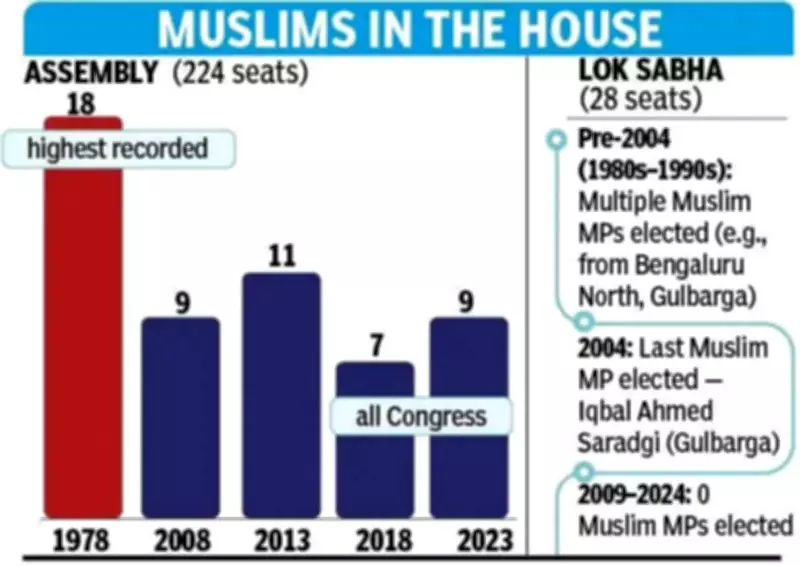
Despite their electoral weight, Muslim representation in Karnataka's political institutions remains notably limited. In the 2023 assembly elections, nine Muslims were elected to the 224-member legislative assembly, an increase from seven in 2018. All of these representatives are from the Congress party, accounting for about 4% of the House.
Of the 32 ministers in the 34-member cabinet, only two hail from the Muslim community: Zameer Ahmed Khan and Rahim Khan. This disparity becomes even sharper at the national level. Karnataka, which sends 28 MPs to the Lok Sabha, has not elected a Muslim representative since 2004.
In recent elections, Muslim candidates formed a small share of those fielded by major parties. Among prominent contenders, Congress's Mansoor Ali Khan lost from Bangalore Central, extending the two-decade absence of Muslim MPs from the state.
Consolidation of Votes and Reduced Bargaining Power
Congress's strong performance in the 2023 assembly elections was widely attributed to the consolidation of Muslim votes. However, some observers argue that this consolidation may have inadvertently reduced the community's bargaining power within the party.
"There is a growing perception that Muslims have no choice but to vote for Congress," said Vishwas Shetty, a political commentator. "Community representatives believed the Davanagere South seat was ideal for a Muslim candidate, given that nearly 40% of the electorate belongs to the community and the Shamanur Shivashankarappa family already has two representations—one in the assembly and another in the Lok Sabha."
Party sources indicate that the decision not to field a Muslim candidate was calculated, citing concerns over the consolidation of Hindu votes in favour of the BJP. This strategic move is being viewed through a longer-term lens, especially with the 2028 assembly elections likely to see anti-incumbency against Congress.
Future Implications and Electoral Dynamics
Any shift of votes away from Congress could alter the political balance in the state. While it remains unclear whether the current discontent will translate into a measurable shift, considering that SDPI is still a fringe party, the outcome of upcoming elections may offer clarity and serve as an early indicator of changing voter sentiments.
The removal of the two Muslim representatives not only highlights internal party strife but also underscores broader issues of inclusion and representation in Karnataka's democracy. As political dynamics evolve, the response of minority communities and the strategies of major parties will be crucial in shaping the state's future electoral landscape.