Congress Leads Major Protest in Gohana Against Haryana's Wheat Procurement Regulations
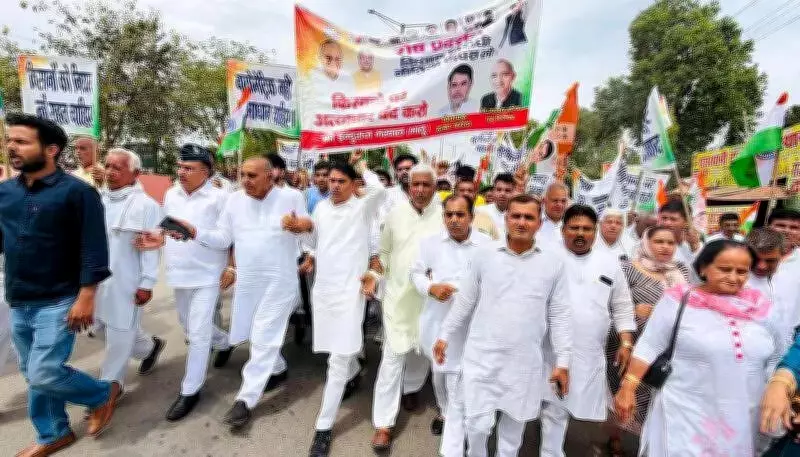
In a significant show of dissent, the Congress party organized a large-scale protest in Gohana, Sonipat, on Friday, targeting the Haryana state government's recently implemented wheat procurement policies. The demonstrators, comprising hundreds of farmers and local residents, condemned the new rules as "arbitrary, impractical and anti-farmer," asserting that these measures severely hinder agricultural trade and disadvantage small-scale producers.
March and Memorandum Submission Highlight Farmer Grievances
The protest was spearheaded by former minister Jagbir Malik and Baroda MLA Induraj Narwal, who led a march from the irrigation department rest house to the mini secretariat. Participants raised slogans and voiced strong opposition, accusing the government of imposing policies without adequate consideration of on-ground realities. They argued that the new system has created substantial obstacles for both farmers and commission agents attempting to sell produce in mandis.
A formal memorandum addressed to Haryana Chief Minister Nayab Singh Saini was submitted through the sub-divisional magistrate (SDM), demanding an immediate rollback of the procurement norms. Tensions flared at the mini secretariat when the SDM was initially unavailable, prompting MLA Induraj Narwal and farmers to stage a sit-in protest. This action forced officials to respond, with the SDM arriving nearly an hour later to accept the memorandum.

Controversial Regulations and Specific Concerns Raised
The protest centers on newly introduced mandi regulations that include mandatory biometric verification, registration on the ‘Meri Fasal Mera Byora’ portal, compulsory number plates on tractor-trolleys, and strict time-bound procurement conditions. According to the protesters, these requirements disproportionately affect small and marginal farmers, with additional hurdles for those using rented machinery or whose land is registered in women's names, limiting their access to procurement centers.
Congress leaders also highlighted serious issues related to incomplete rabi crop registration, noting that a large number of farmers are unable to sell wheat due to a lack of portal registration. The party demanded that the portal be reopened immediately to ensure wider access and called for urgent reforms to simplify procedures, enhance transparency, and adopt a more farmer-friendly approach.
Partial Victory and Warnings of Escalation
Following the protest, Congress leaders claimed that mounting pressure compelled the government to respond, with authorities now assuring 24-hour procurement of crops. However, they described this as only a partial victory, warning that the agitation would intensify unless all "anti-farmer" provisions were withdrawn. The leaders cautioned that failure to address these issues promptly could trigger large-scale unrest, holding the government accountable for any escalation and reiterating their commitment to continue the struggle until the rules are scrapped.