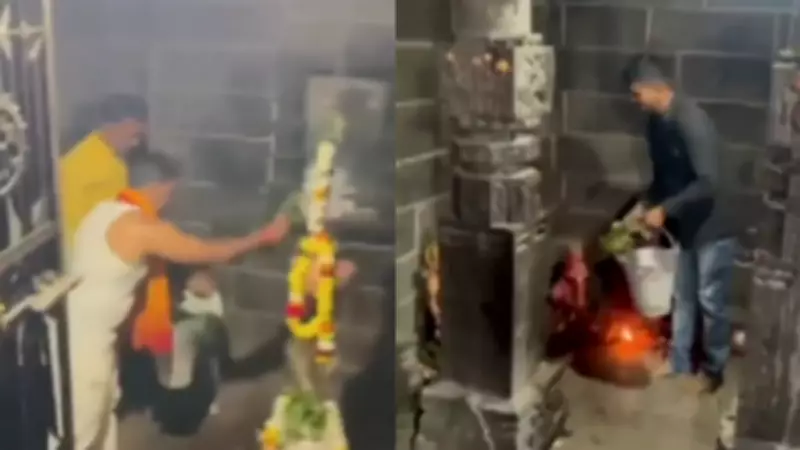
BJP Workers Conduct Temple Purification with Gomutra Following Shiv Sena MLA's Visit in Maharashtra
A recent incident in Maharashtra has ignited a political firestorm after a video went viral on social media platforms. The footage captures Bharatiya Janata Party (BJP) workers performing a purification ritual at a temple using gomutra, or cow urine, shortly after a visit by Shiv Sena MLA Abdul Sattar. This event has drawn sharp criticism from opposition parties and raised concerns about communal tensions in the state.
Details of the Viral Video and Temple Incident
The video, which has been widely circulated online, shows BJP activists sprinkling gomutra around the temple premises in what they described as a cleansing ceremony. According to reports, this action was taken after Abdul Sattar, a legislator from the Shiv Sena party, visited the temple as part of his official duties. The BJP workers claimed that the ritual was necessary to purify the sacred space, alleging that Sattar's presence had desecrated it due to his religious background.
Eyewitnesses and local sources indicate that the incident occurred in a rural area of Maharashtra, where temple visits by politicians are common during election seasons or community events. However, the use of gomutra for purification has added a controversial dimension, with many viewing it as a deliberate attempt to stoke religious divisions. The temple authorities have not issued an official statement, but the video has prompted discussions about the intersection of politics and religion in public spaces.

Political Reactions and Allegations of Communalism
In response to the viral video, political leaders from various parties have voiced their opinions. Shiv Sena members, including Abdul Sattar himself, have condemned the BJP's actions as communally charged and an insult to secular values. Sattar stated that his visit was purely administrative and aimed at addressing local issues, emphasizing that such rituals undermine social harmony.
Opposition figures, such as those from the Congress and Nationalist Congress Party (NCP), have accused the BJP of using religious symbols to polarize voters ahead of upcoming elections. They argue that incidents like this reflect a broader pattern of divisive politics that threatens India's pluralistic fabric. On the other hand, BJP representatives have defended the purification ritual, citing it as a traditional practice to maintain the sanctity of Hindu temples. They insist that the action was not targeted at any individual but was a routine religious observance.
Broader Implications for Maharashtra's Social and Political Landscape
This event highlights ongoing tensions in Maharashtra, where political rivalries often intersect with religious and cultural identities. The use of gomutra in this context has sparked debates about the appropriateness of such rituals in public life and their potential to alienate minority communities. Experts note that similar incidents have occurred in the past, contributing to a climate of mistrust and conflict.
Moreover, the viral nature of the video underscores the role of social media in amplifying political controversies. As the footage continues to circulate, it has drawn attention from national media outlets and civil society groups, calling for greater accountability from political actors. The incident may influence voter perceptions in Maharashtra, particularly in regions where communal issues are sensitive.
In conclusion, the purification ritual performed by BJP workers at a temple in Maharashtra after Shiv Sena MLA Abdul Sattar's visit has become a focal point for political discourse. While the BJP frames it as a religious duty, critics see it as a manifestation of communalism that could destabilize social cohesion. As investigations and discussions proceed, this case serves as a reminder of the delicate balance between politics and religion in India's diverse democracy.