In a significant political development in Maharashtra's Amravati district, the Bharatiya Janata Party (BJP) fell short of its pre-election claims of a clean sweep, managing to secure only six out of the twelve municipal council and nagar panchayat president posts for which elections were recently held. The polls, conducted across ten municipal councils and two nagar panchayats, delivered a mixed bag of results, highlighting a competitive political landscape where Congress and several regional parties made notable inroads.
Key Wins and Major Upsets in President Elections
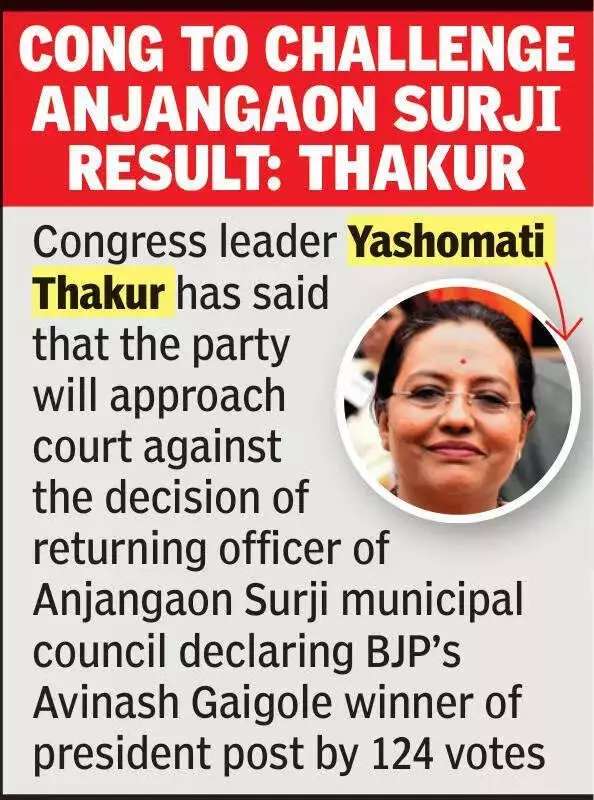
The BJP saw victories in several municipal councils. Rupali Mathne, Archana Adsad, Ishwar Salame, Suvarna Warkhede, and Avinash Gaigole were elected presidents of Achalpur, Dhamangaon Railway, Warud, Shendurjana Ghat, and Anjangaon Surji municipal councils respectively. The party also won the Dharni nagar panchayat president post with candidate Sunil Chauthmal.
However, the party faced a major setback in the prestigious Chikhaldara municipal council. Here, Congress candidate Sheikh Abdul Sheikh Haider defeated BJP's Rajendra Somwanshi, a three-time municipal council president whom the BJP had recently inducted from the NCP (AP) camp with the help of Yuva Swabhiman Party MLA Ravi Rana. Congress won 12 of the 20 councillor seats in Chikhaldara, while BJP bagged 8, including the unopposed seat of Alhad Kaloti, the maternal cousin of Deputy Chief Minister Devendra Fadnavis.

Detailed Council-Wise Performance and Seat Share
A closer look at the councillor seat distribution reveals the fragmented nature of the verdict. In Anjangaon Surji, BJP could win only 6 of the 28 municipal councillor posts. Congress secured nine, Shiv Sena (UBT) seven, Shiv Sena (Shinde) three, Samajwadi Party two, and an Independent one.
In contrast, BJP displayed total dominance in Dhamangaon Railway, winning all 20 councillor seats. Congress, however, struck back in Daryapur municipal council, where Mandakini Bharsakle, wife of co-operatives leader Sudhakar Bharsakle, was elected president by defeating Pradeep Maliye of Shiv Sena. Congress also won a commanding 17 of the 25 councillors' seats here.
Regional Parties Make Their Mark
The elections underscored the influence of regional players. The Prahar party, led by former minister Bachchu Kadu, captured the Chandur Bazar president post. The winner, Manisha Nangliya, had joined Prahar after being denied a ticket by the BJP. Prahar also won 13 of the 20 councillors' seats in this council.
In Chandur Railway, a panel named 'Apla Chandur' led by VBA leader Dr. Nilesh Vishwakarma caused an upset. His wife, Dr. Priyanka Vishwakarma, won the presidential battle against BJP's Swati Mete. However, BJP won 11 of the 20 seats here, with Congress getting four, Independents and VBA two each, and CPI one.
In other results, Shiv Sena (UBT) candidate Prapti Vilas Marodkar won the Nandgaon Khandeshwar nagar panchayat president's post by a margin of 450 votes. The seat share saw Shiv Sena (UBT) and Congress winning five each, BJP three, NCP(SP) two, and NCP(AP) and Prahar one each out of 17 seats.
Shiv Sena (Shinde) candidate Pratiksha Gulhane secured the Morshi municipal council president's post, defeating an independent candidate by 1,428 votes. Despite this win, Shinde Sena could win just two of the 24 councillor seats. BJP, Congress, and NCP (SP) won six seats each, NCP (AP) got two, while Prahar and an independent won one each.
Analysis and Political Implications
The results from Amravati district's civic polls present a nuanced picture of Maharashtra's politics ahead of larger elections. While the BJP remained a key player, its performance did not match its ambitious pre-poll rhetoric. The Congress party demonstrated resilience by winning significant posts and seats, particularly in key councils. The strong showing by regional parties like Prahar and independent panels indicates that local issues and leadership continue to hold substantial sway in grassroots democracy. This verdict is likely to be analyzed by all major parties as they recalibrate their strategies for upcoming electoral battles in the state.