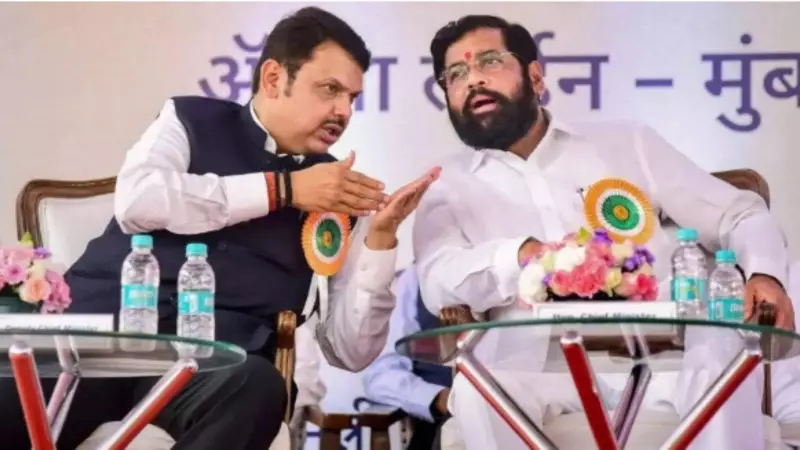
As Maharashtra gears up for elections across 29 municipal corporations on January 15, the ruling Mahayuti alliance presents a picture of discord rather than unity. The Bharatiya Janata Party (BJP) and the Shiv Sena led by Chief Minister Eknath Shinde have managed to stitch together a pre-poll alliance in only 14 of the civic bodies, exposing deep-seated conflicts and a half-hearted partnership that has defined their one-year-old state government.
A Patchwork of Alliances
The failure to reach an understanding in the remaining 15 corporations underscores the in-built tensions within the coalition. Chief Minister Devendra Fadnavis had earlier indicated that the alliance would not be uniform statewide, focusing instead on Mumbai and the metropolitan region. This prediction has materialized, with sharp differences over seat-sharing formulas preventing pacts in major urban centers like Pune, Pimpri-Chinchwad, Nashik, and Navi Mumbai.
Shiv Sena leaders have voiced significant disappointment over the BJP's rigid stance. Minister Sanjay Shirsat remarked that BJP leaders appeared unaccommodating, particularly in key civic bodies such as Pune, Chhatrapati Sambhajinagar, and Nashik. The discontent has spread to the Nationalist Congress Party (NCP) faction led by Deputy CM Ajit Pawar, who publicly questioned, “How long should one tolerate BJP’s terror?” at a rally in Pimpri-Chinchwad.
The Compulsions Behind the Pact
Political analysts suggest the alliance in the 14 corporations is born out of necessity, not choice. The BJP has chosen partnership only in civic bodies where it lacks the confidence to secure victory on its own. The permutation and combination of local equations in these areas make a solo venture too risky. The same logic applies to the Shiv Sena, which leveraged this compulsion to drive a hard bargain, especially in Mumbai and its stronghold of Thane.
In Mumbai's Brihanmumbai Municipal Corporation (BMC) elections, which hold special significance, Shinde's Sena successfully negotiated for 90 seats, leaving the BJP with 137. The BJP's attempt to restrict its ally to 75-80 seats failed, highlighting Shinde's strategic maneuvering. The central BJP leadership has directed its cadre to treat the BMC polls as a 'do or die battle', driven by the desire to wrest control from the Uddhav Thackeray-led Shiv Sena (UBT), for whom the BMC is a political lifeline.
Where Alliances Were Forged and Fractured
The 14 corporations where the BJP and Shiv Sena are contesting together include Mumbai, Thane, Kalyan-Dombivli, Nagpur, and Jalgaon. In contrast, the 15 where they are going solo, besides those already mentioned, include Amravati, Malegaon, Akola, Mira-Bhayandar, Dhule, Ulhasnagar, Sangli, Jalna, and Latur.
The third Mahayuti partner, the NCP, has added another layer of complexity by aligning with the Sharad Pawar-led NCP (SP) in some places and with the BJP or Shiv Sena separately in others. An NCP leader criticized the BJP's approach, stating, “We know BJP uses every alliance partner to serve their own party’s interest.”
Government Stability and Future Equations
Despite the public bitterness, state BJP president Ravindra Chavan asserted that alliances were formed based on ground realities and organizational strength where the formula was acceptable to both partners. He emphasized that the Fadnavis government remains strong and stable with 137 MLAs, and even a hypothetical withdrawal of support by Shiv Sena (57 MLAs) and NCP (41 MLAs) would not threaten its majority.
However, the future dynamics within the coalition government will likely be influenced by the electoral outcome. A stronger performance by the BJP could make it more assertive, while a good showing by Shinde's Sena and Ajit Pawar's NCP would bolster their bargaining power in governance.
Following the municipal corporation polls, elections for zilla parishads are scheduled next month. The results will set the tone for the long political haul leading to the Assembly and Lok Sabha elections in 2029, making these civic polls a crucial test for the fragile Mahayuti alliance.