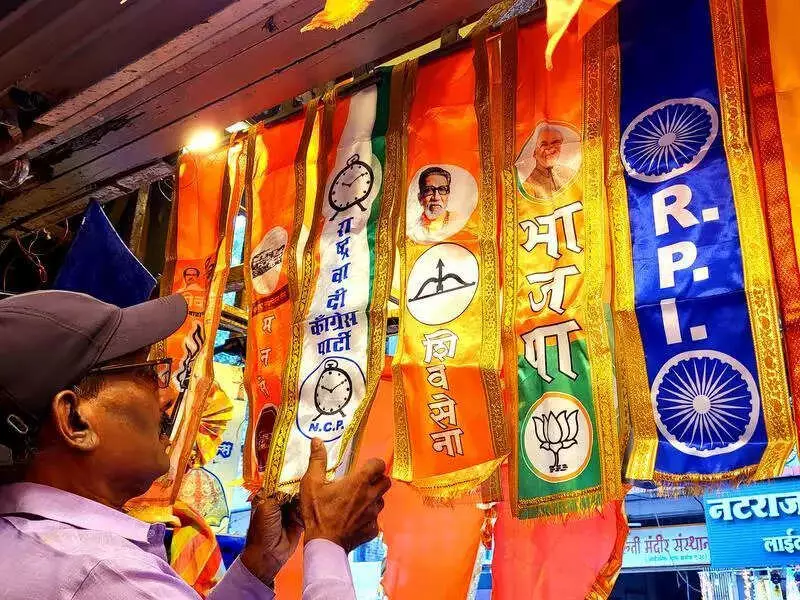
The political landscape in Maharashtra has witnessed a significant rupture as the ruling alliance partners at the state and central level, the Bharatiya Janata Party (BJP) and the Shiv Sena, have decided to go their separate ways for the crucial municipal corporation elections. With polls scheduled for January 15 across the state's 29 municipal corporations, the two saffron parties are set to lock horns directly in more than 15 of them, marking a dramatic shift from their united front in the recent assembly elections.
Alliance Talks Collapse, Setting Stage for Direct Fights
The final opportunity for an electoral pact vanished as the deadline for withdrawing nominations ended on Friday. This cemented the scenario of partners within both the ruling Mahayuti and the opposition Maha Vikas Aghadi (MVA) challenging their own allies in a majority of the civic bodies. Initially, Chief Minister Devendra Fadnavis had expressed confidence that the BJP and Shiv Sena would contest the local polls together, with the third Mahayuti ally, the NCP, engaging in only "friendly fights." However, the reality turned out to be starkly different.
Despite last-minute efforts and negotiations, the two parties could only finalize seat-sharing agreements in eight corporations: Mumbai, Thane, Kalyan-Dombivli, Vasai-Virar, Panvel, Chandrapur, Nagpur, and Kolhapur. In major urban centers like Pune, Pimpri Chinchwad, and Chhatrapati Sambhajinagar, the alliance failed to materialize. Shiv Sena leaders had remained hopeful until the final hours, with minister Uday Samant anticipating a formula would be found. The breakdown has left local cadres frustrated.

Local Leaders Express Frustration as Blame Game Ensues
Ravindra Dhangekar, the Shiv Sena's Pune unit chief, voiced his disappointment, stating that the party had waited in vain for a directive from the top leadership. "The scenario is clear now. We feel it was our mistake that we relied on BJP and did not field candidates on all the 165 seats in the Pune Municipal Corporation (PMC)," Dhangekar told reporters. While local functionaries from both sides are engaged in a blame game over the failed negotiations, political observers see a larger, strategic motive behind the split, particularly from the BJP's side.
A Strategic Move for 2029?
Analysts believe the BJP is using these municipal polls as a testing ground to independently gauge and expand its organizational strength across Maharashtra. Political analyst Parimal Maya Sudhakar explained that despite the BJP's strong performance in the 2014, 2019, and 2024 assembly elections, it has not secured an absolute majority on its own. "Now with a massive number of MLAs (132) on its side, BJP is using the municipal corporation polls as an opportunity to gauge its strength in the state," Sudhakar said.
He further noted that the relative weakness of the formal opposition in the state has created a vacuum. The parties within the ruling Mahayuti coalition are now exploiting this space to contest against each other without the immediate threat of a strong opposition bloc. "They are now utilising the vacuum in the opposition camp to expand their base," Sudhakar added, suggesting these civic polls are a precursor to the larger battle for the 2029 state assembly elections.
Implications for Maharashtra's Political Future
The decision of the BJP, Shiv Sena, and NCP to contest separately in the civic polls, despite being partners in the state government, underscores the complex and competitive nature of Maharashtra's politics. It signals a return to hard-nosed political calculations where local dominance takes precedence over coalition harmony. The outcome of the January 15 polls will not only determine control of key urban local bodies but will also provide critical data on each party's standalone voter appeal, potentially reshaping alliances and strategies for the next half-decade. The stage is set for a fiercely competitive election that will be closely watched as a barometer of shifting political loyalties at the grassroots level.